


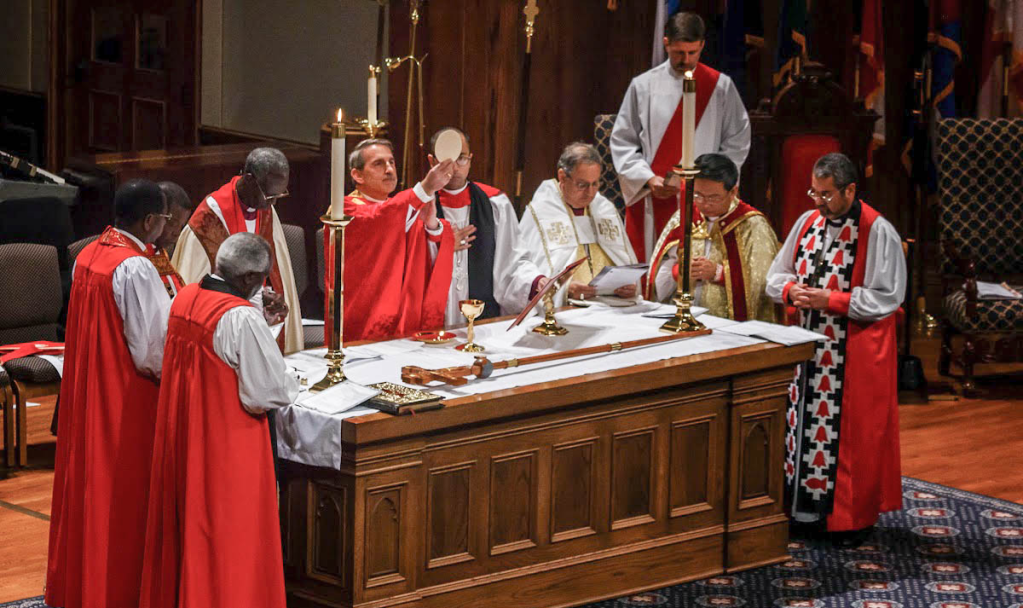
Anglican liturgy has always been understood as an image of the Kingdom of God. This is explored in Dr Jasmin Milić’s book, Blagoslovljeno kraljevstvo Njegovo (Blessed Be His Kingdom). Below is an excerpt from the book.
Anglican Liturgy – An Image of the Kingdom of God
According to the 2019 Book of Common Prayer (ACNA), the opening acclamation reads: “Blessed be God: Father, Son, and Holy Spirit. And blessed be his kingdom, now and for ever.” This form is drawn from the ancient Eastern Liturgy of St John Chrysostom,[1] while its roots lie in the Jewish prayer of berakah—from the Hebrew word meaning “to bless”—with which the Jewish people blessed God.[2] Christians believe in the Triune God. God reveals himself as such in his Word. Christians are baptised in the name of the Triune God and profess their faith in the Trinity.
Everything Christians do, they do in God’s name; worship therefore also begins with a blessing, or invocation, of the Triune God. Here we should also emphasise the connection between the sacraments of Baptism and the Eucharist—the two sacraments recognised as such by the Reformation tradition.[3] Through Baptism, believers begin their lives within the Church, while the culmination of their participation in the Church’s life is their coming to the Lord’s Table, that is, their participation in the Eucharist.
Other liturgical traditions also begin worship in the name of the Triune God, for example: “In the name of the Father, and of the Son, and of the Holy Spirit,” or with the Grace: “The grace of the Lord Jesus Christ, the love of God, and the fellowship of the Holy Spirit be with you all.” These opening greetings likewise express faith in the Triune God, in whose name worship begins.
The opening acclamation also seeks to emphasise the eschatological reality of worship. Worship is not merely a commemoration of something that happened in history, but a foreshadowing of something yet to come:
“…a foreshadowing of the Kingdom of God in its fullness, a foretaste of the eschatological banquet in the Kingdom of God, the beginning, guarantee and pledge of future glory in Christ, the proclamation and beginning of the eschatological age, the age of good things to come, of which the present age is only a shadow (Hebrews 10:1; cf. 8:5; Colossians 2:17).”[4]
Worship proclaims that the Kingdom of Heaven has drawn near and that the Saviour’s preaching has begun: “…Jesus came into Galilee, proclaiming the good news of God. He said, ‘The time is fulfilled, and the kingdom of God is near. Repent and believe in the good news!’” (Mark 1:14b–15). The Lord’s Prayer, the Our Father, given to us by the Lord himself, also begins with the expectation of the Kingdom of Heaven and the petition for its coming: “Your kingdom come” (Matthew 6:10).
The Kingdom of God takes concrete form in knowing God, loving him, being united with him and living in him. The Kingdom of God is therefore the substance of Christian life. There is no Christian life without union with God as the source of life, indeed as Life itself—Jesus calls himself the Life. The Kingdom of God is therefore the substance of eternal life: “And this is eternal life: that they may know you…” (John 17:3).
Human beings were created precisely for this complete fellowship with God, to honour God as King. Yet by sinning, humanity rejects its God and King. Through sin, evil, suffering and death came to rule the world. Satan became the ruler of this world. But God did not abandon humanity. The Eucharistic Prayer of St John Chrysostom says:
“You brought us from non-existence into being, and when we had fallen, you raised us up again. You did not cease doing everything until you had brought us into heaven and granted us your kingdom which is to come.”[5]
It was this future Kingdom that the prophets of the Old Testament awaited, prayed for and proclaimed. With the coming of Christ, the time was fulfilled and the Kingdom of Heaven drew near. Christ came to grant humanity forgiveness of sins, peace with God and new life. Through his death on the cross and resurrection from the dead, Christ became King of all those whom he called into his Kingdom. The earliest Christian confession of faith was: “Jesus Christ is Lord.”
In the early centuries, Christians were persecuted because they refused to acknowledge anyone as King other than Christ. Christ came and established his Kingdom in the hearts of those who have been born again through him. Yet Christ’s final reign will be revealed when he returns in power and glory as King. This is why Christ’s Kingdom is “already here, but not yet.” We confess this in the final part of the opening greeting: “…now and for ever. Amen.” Christ has come, Christ comes, Christ will come again. This was also the hope of the first Christians when they greeted one another with the Aramaic expression Maranatha—“Come, Lord Jesus!”[6]
When we say, “And blessed be his kingdom…”, blessing the Kingdom means more than acclaiming and praising it. We confess that the Kingdom of God is:
“…our goal, the fulfilment of all our desires and interests, of our entire life, the highest and ultimate value of our whole existence.”[7]
Only those to whom the ultimate purpose of all life has been revealed can make this confession.
In a certain sense, the Church is a procession—from the Latin processio, “advancing,” derived from pro, “forward,” and cedere, “to move, to walk”[8]—a journey towards the heavenly homeland, the heavenly Kingdom, while worship is an image of that Kingdom.
“God’s chosen people of the Old Covenant were, in fact, constantly on the move, on a journey: from Egypt to Canaan, from captivity to Jerusalem. The Bible describes this caravan as a great festive procession with singing, music and banners (Numbers 9–10; Joshua 6)…. Even after returning to their homeland, the Hebrews remain a pilgrim people.”[9]
The procession of the clergy at the beginning of worship is therefore no accident. In ancient times, a procession was the customary way in which the clergy and people entered the church. In his celebrated work Mystagogy, St Maximus the Confessor speaks of the people entering together with their bishop as:
“…the return of unbelievers from ignorance and error to the knowledge of God, and the passage of believers from vice and ignorance to virtue and knowledge…”[10]
We find a procession in Jesus’ entry into Jerusalem and in his journey bearing the cross towards Golgotha. The clergy in the procession represent the whole community of believers coming to worship. This processional movement rests on the conviction that we are pilgrims on earth who seek to live a new life by the Holy Spirit (Galatians 5:25).
“Being moved by the Spirit must not be confined to stillness. Translated into liturgical celebration, this means that walking in procession is, in fact, prayer expressed through bodily movement. The Church cannot remain motionless, because it has been caught up in the event of Pentecost and in the presence of Christ, who walks before it and with it, so that it may leave the slavery of sin and journey towards the land of fulfilled promises. Walking expresses the ‘already, but not yet’ of salvation, the Christian eschatological tension, the boundary and dividing line experienced by a person within themselves and in their relationships with others.”[11]
From ancient times, the cross has stood at the head of the procession. The way to the heavenly Kingdom has been opened to us through Christ’s sacrifice (Hebrews 10:19–20). The cross is a powerful symbol of that sacrifice, of the union of heaven and earth, and of humanity’s journey towards the Kingdom. In worship, the cross is a symbol of Christ’s presence among us. Behind the cross, a deacon or another minister carries the Gospel Book held aloft. Our journey towards the heavenly Kingdom is sustained and illuminated by God’s Word.
Worship, especially Eucharistic worship, should be understood as a procession or journey. It is the Church’s journey into the realm of the Kingdom of Heaven. What must we do to come to worship? We leave our beds, our homes and our everyday responsibilities. From daily life, from this world, we journey together with others who are also coming to worship, so that we may be gathered in one place. This is expressed powerfully in the earliest recorded Eucharistic prayer, found in the early Christian writing known as the Didache—“The Teaching of the Apostles,” written between AD 80 and 100:
“As this broken bread was scattered upon the hills and, being gathered together, became one, so may your Church be gathered from the ends of the earth into your kingdom…. Remember, Lord, your Church: deliver it from all evil and perfect it in your love; and gather it, made holy, from the four winds into your kingdom which you have prepared for it, for yours are the power and the glory for ever. May your grace come, and may this world pass away. Hosanna to the God of David.”[12]
We live in a concrete world as individual people, differing from one another in many ways. Yet when we gather for worship, we become the Church in its fullness. We go to church in order to be the Church fully. Worship must therefore be understood as far more than a shared gathering for prayer. In worship, we are the Church in the fullest sense, and the reality of the Kingdom of God is made present.
This is why someone who does not participate in the Church’s worship does not know Christ. After his resurrection, even Christ’s own disciples did not recognise him until he revealed himself to them in the breaking of bread (Luke 24:15–16, 30).[13] In worship, we ascend to heaven itself, where Christ is. This encounter changes and transforms us, just as Moses was transformed after meeting God on Sinai (Exodus 34:29). An ancient liturgical hymn expresses this beautifully:
“Let us who mystically represent the Cherubim, and who sing the thrice-holy hymn to the life-giving Trinity, now lay aside every earthly care, that we may receive the King of all, invisibly escorted by the angelic hosts: alleluia, alleluia, alleluia.”[14]
We must therefore not neglect worship, the gathering of the community, the concrete place of the Kingdom of God on earth. If we are unwilling to leave our everyday lives and gather in one place at an appointed time to be the Church in a concrete way, the question arises: to what extent are we truly part of Christ’s Church on earth? Services on the internet or television, however useful, can never replace the Church. There is no actual fellowship there; we are not gathered with a particular congregation in a particular place—we are merely observers. Most importantly, we cannot enjoy the blessings of Eucharistic communion.
A person without worship, without the Eucharist and without fellowship with the other members of Christ’s body is, in fact, outside the Church. It is impossible to be a Christian without participating in the Church’s worship. The first Christians did not “go to church”; rather, they “came together as a church” (1 Corinthians 11:18).
The Kingdom of God is manifested especially in Eucharistic worship, in which we are spiritually united with Christ and which reminds us of what Christ has done for us in the past, what he does in the present and what he will do in the future: Christ has come, Christ comes, Christ will come again. When we come to worship, we are not attending an ordinary gathering, a meeting of people united only by shared interests, a common faith or similar ties. We enter sacred time, in which Christ, the Ruler and King of all time and all creation, is present in a special way through his Word and through the sacrament of the Lord’s Supper, in which we receive him spiritually by faith.[15]
The Church is a community united, strengthened and preserved by the Holy Spirit. Where there is no Holy Spirit, there is no Church. He gives the Church its gifts and ministries. He calls believers to Christ, leads them to repentance and grants them his fruit, which bears witness to sanctification. All these are signs of the presence of the Kingdom of God in Christ’s Church.
Sunday—an image of the Kingdom to come. The gathering of the community on the Lord’s Day, the first day of the week—or, as the Church Fathers call it, the eighth day—also leads us symbolically into eschatological reflection on the Kingdom of Heaven. With Sunday, that is, with Christ’s resurrection, the “new creation” begins.
“For Christ, who is the firstborn of all creation, also became the beginning of a new race, which he himself brought to new birth…”[16]
The Eucharist is the joyful anticipation of our encounter with the risen Lord. Sunday is the day “the Lord has made,” as the psalmist says (Psalm 118:24). The eternal Sunday, the eternal eighth day, never passes away. Worship in eternity never passes away; the encounter with Christ in eternity never passes away. This is a reason for immeasurable joy. Our worship should therefore be filled with true joy, because it is the reality of eternity on earth, an image of everlasting joy.
From Easter until Pentecost, the Church remembers Christ’s resurrection in a special way through the early Christian acclamation: “Alleluia. Christ is risen!” The people respond: “The Lord is risen indeed. Alleluia!” This is the traditional Easter greeting, based on Luke 24:34.
During Lent and other penitential seasons, the Church turns to the merciful Lord who forgives all our sins. The acclamation, “Bless the Lord who forgives all our sins…”, is based on Psalm 103:1–3 and Psalm 136, in which the refrain “his love endures for ever” is repeated after each verse. His love speaks of his mercy towards those whose sins he forgives.
The God whom we worship has conquered death; the God whom we worship forgives our sins. Worship is the place where this is revealed to us in a special way. Meeting the King, meeting the living Christ in worship, is therefore a privilege for every believer. We already participate in the Kingdom of God here on earth. The future Kingdom of God can be a reality only for those who participate in that Kingdom now, on this earth. Worship is an indispensable part of that participation.
Author: Bishop Jasmin Milić
This text is an excerpt from Jasmin Milić’s book, Blessed Be His Kingdom: An Exposition of Eucharistic Worship According to the Book of Common Prayer.
Read the latest newsletter of the Pannonian-Danubian Diocese: REFORMED EPISCOPAL PANNONIAN-DANUBIAN DIOCESE – NEWSLETTER 2/2026
Notes
[1] The Liturgy of St John Chrysostom (born in Antioch between 344 and 354; died in Comana on 14 September 407) is preserved today in the worship of the Eastern Churches. See: Bizantsko-hrvatski liturgikon [Byzantine-Croatian Liturgicon], Zagreb: Glas Koncila, 1999.
[2] Cf. V. ZAGORAC, Dođi kraljevstvo tvoje [Your Kingdom Come], Zagreb: Croatian Institute for Liturgical Pastoral Ministry of the Croatian Bishops’ Conference, 2008, pp. 9–14.
[3] The Catholic and Orthodox traditions accept the teaching of seven sacraments, or Holy Mysteries: Baptism, Confirmation/Chrismation, Eucharist, Confession, Anointing of the Sick, Holy Orders and Matrimony.
[4] A. REBIĆ, Biblijsko-povijesni vidovi euharistije i križa [Biblical and Historical Aspects of the Eucharist and the Cross], Zagreb: Kršćanska Sadašnjost, 2005, p. 54.
[5] Bizantsko-hrvatski liturgikon, p. 80.
[6] Cf. A. SCHMEMANN, Evharistija [The Eucharist], Hilandar Monastery, 2002, pp. 31–32.
[7] A. SCHMEMANN, Za život sveta [For the Life of the World], Belgrade: Pravoslavlje, 1979, p. 27.
[8] The first processions appeared in Rome in the fourth century.
[9] M. BABIĆ, Liturgika, 1. dio [Liturgics, Part 1], Split: Catholic Faculty of Theology, course notes, 2010.
[10] St Maximus the Confessor, Izabrana dela [Selected Works], Prizren: Diocese of Raška and Prizren, 1997, p. 195.
[11] I. ŠAŠKO, Liturgijski simbolički govor [Liturgical Symbolic Language], Zagreb: Glas Koncila, 2005, pp. 76–77.
[12] Crkveni Oci, Apostolski Oci II [Church Fathers: The Apostolic Fathers II], Zagreb: Verbum, 2010, pp. 24–25.
[13] Cf. A. SCHMEMANN, Za život sveta [For the Life of the World], pp. 25–26.
[14] Bizantsko-hrvatski liturgikon, p. 74.
[15] For an interesting article on Eastern theology’s understanding of the Eucharist as the Kingdom of God, see J. ZIZIOULAS, “Evharistija i Carstvo Božje” [The Eucharist and the Kingdom of God], in Beseda, vol. 6, Novi Sad, 2006, pp. 5–40.
[16] JUSTIN MARTYR, Razgovor s Trifunom [Dialogue with Trypho], chapter 138, Zagreb: Verbum, 2011, p. 236.
Cover photograph: Wikipedia (Liverpool Anglican Cathedral).