


There are certainly moments in our lives when we feel we have “had enough.” Even the great heroes of faith in the Bible experienced this. The prophet Elijah offers us one such example.
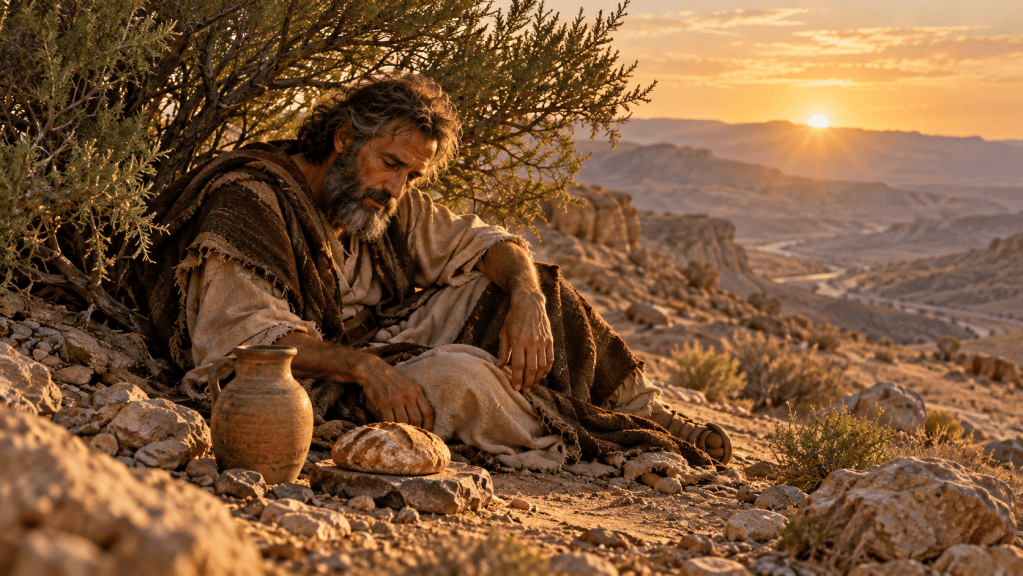
In those days, Elijah went a day’s journey into the wilderness. He came to a broom bush, sat down beneath it, and wished that he might die. “I have had enough, Lord,” he said. “Take my life, for I am no better than my ancestors.” Then he lay down and fell asleep there. Suddenly, an angel touched him and said, “Get up and eat.” He looked, and there beside his head were a loaf of bread baked on hot stones and a jar of water. He ate and drank, and then lay down again. The angel of the Lord came a second time, touched him, and said, “Get up and eat, for the journey ahead is too much for you.” So he got up, ate and drank. Strengthened by that food, he travelled for forty days and forty nights until he reached Horeb, the mountain of God.
1 Kings 19:4–8
The Old Testament prophets were “the living voice of God.” They would begin or end their messages with the words, “Thus says the Lord.” The ministry of a prophet was essentially a ministry of preaching. They proclaimed God’s message fearlessly and without compromise to the great and the small alike, ready even to suffer for the truth of God’s Word.
One of the most significant prophets of the Old Testament was Elijah. His name in Hebrew means “My God is Yahweh,” or “My God is the Lord.” He lived in the ninth century BC. He came from Tishbe, which is why he is also called the Tishbite. He first appears in the seventeenth chapter of the First Book of Kings, and we know little about him before that point.
When We Have “Had Enough” – An Example from the Life of the Prophet Elijah
As his story unfolds, we see him as a fearless opponent of idolatry—the worship of false gods. We also know the account of his being taken up to heaven amid “chariots of fire.” According to the biblical account, he did not die as other mortals do. This gave rise to a popular belief among our own people and other Slavic peoples that St Elijah causes thunder. Hence the name “St Elijah the Thunderer.” Of course, this belief has no basis in the Bible. What is certainly true, however, is that Elijah thundered forth the Word of God.
The prophet Elijah ministered during the reign of King Ahab. For economic reasons, Ahab married Jezebel, a Phoenician woman who worshipped the Phoenician “god” Baal. She won her husband Ahab over to idolatry, and the worship of this false god consequently spread among God’s people. Elijah’s appearance was therefore deeply troubling to Ahab. He said to Elijah, “Is that you, you troubler of Israel?” (1 Kings 18:17). But Elijah answered him fearlessly: “I have not brought trouble on Israel, but you and your family have, because you have abandoned the Lord, and you have followed Baal” (1 Kings 18:18).
During this encounter with Ahab, Elijah challenged the priests of Baal to a “battle.” He asked Ahab to gather the people of Israel and the 450 prophets of Baal. When Ahab had done so, Elijah delivered a powerful address, calling on them to decide whom they would follow: Baal or the Lord. God’s people were trying to have it both ways—or, as Elijah puts it here, they were “limping between two opinions” (1 Kings 18:21).
Elijah then challenged the priests of Baal to a spiritual contest. He asked them to offer a sacrifice, and he would do the same. Each side would offer a bull, but neither would light the fire. Let fire come down from heaven: the acceptance of the sacrifice would reveal who was truly God. The priests of Baal prepared their sacrifice first. They performed their rituals, leaped about, bent their knees for hours, and called upon Baal, but there was no answer. Elijah even mocked them: “Shout louder, for he is a god! Perhaps he is occupied, or busy, or away on a journey. Perhaps he is asleep and must be awakened!” (1 Kings 18:27). Still, there was no answer.
Then Elijah offered his sacrifice. He stood alone against 450 prophets of Baal. He laid the sacrifice on the wood and even had water poured over it. When everything was ready, Elijah prayed: “O Lord, God of Abraham, Isaac and Israel, let it be known today that I am your servant and that I have done all these things at your command. Answer me, Lord, answer me, so that all these people may know that you, Lord, are God, and that you are turning their hearts back to you” (1 Kings 18:36–37).
God answered Elijah’s prayer. Fire came down from heaven, and all the people cried out: “The Lord is God! The Lord is God!” What a glorious victory! What joyful acclamation! In a sense, the people were proclaiming Elijah’s very name, for, as we have said, his name declares that the Lord is God.
Elijah put the prophets of Baal to death. In today’s context, we find this and similar events difficult to understand. Yet this was understood as removing from among the people the evil that promoted idolatry. Idolatry—the worship of other, false, nonexistent gods—is one of the gravest sins against God.
When Jezebel heard from Ahab what had happened, she threatened Elijah. She was determined to have him killed. Elijah’s reaction was unexpected: “He was afraid…” (1 Kings 19:3). Could the fearless Elijah really have become afraid? He had thundered forth God’s Word, been ready to suffer, and stood up to the king himself—and now he was afraid.
Elijah, too, was only human, just as we are (James 5:17). He had reached a dead end, lost heart, and was ready to give up. Fear had overwhelmed him. Fear is a normal human emotion. We cannot always be strong, cheerful and carefree. Moments of anxiety, fear and uncertainty also come. The thought of death awakens fear in us. Christ himself experienced anguish as he prayed in the Garden of Gethsemane, asking that the cup he was to drink might pass from him—a reference to his approaching death.
Elijah fled to save his life. He went to Beersheba in Judah and then continued another day’s journey. We can only imagine how exhausting all this must have been: hungry and thirsty in the desert heat, fearing for his own life. At one point, finding some shade beneath a bush, he reached his limit: “I have had enough, Lord…”
Elijah could no longer see a way forward. His physical strength had failed him, and he was emotionally exhausted. He could see no solution, did not know where to go, and had no idea what lay ahead. How often have we found ourselves in a similar situation, whether because of problems weighing upon us or concerns about our own health or that of our loved ones?
When people reach a dead end, many give up. Some are even prepared to go so far as to take their own lives. This shows us how deeply painful it is to feel powerless, to lose all hope, and to have nothing secure to hold on to.
During his prayer on Mount Carmel, Elijah called upon the God of Abraham, Isaac and Israel. The God who acted in the past is also at work in the present. Remembering God’s deeds helps us trust in the God who is not only the God of the past, but also of the present and the future. We understand Christ in the same way: “Jesus Christ is the same yesterday and today and for ever.”
Yet such memories can sometimes produce two different responses. At times, they inspire deep trust in the God who acted in the past. At other times, we ask: Where is God now? Why does he not deliver me now, when I have given him my whole life, served him faithfully, and suffered for him?
We do not know what was going through Elijah’s mind at that moment, but we do know that he had had enough. He even wished to die. He could no longer cope with it all.
When We Have “Had Enough”
If we find ourselves in a similar situation, we should not assume that our faith is weak. If we are willing to share it with God and tell him everything that troubles us, God will surely make his presence and power known in our lives as well.
The angel of the Lord touched Elijah. God’s touch is one of the most precious things we can experience. When we are ready to give up even on life itself, a single word or a touch from someone we trust, someone who matters to us, can give us renewed strength and a fresh desire to live. When we speak to God about our feelings, he will touch us, renew our strength, and sustain us.
“Get up and eat,” the angel said to Elijah. Beside his head were bread and a jar of water. Bread and water represent our most basic human needs. They are enough to nourish us, sustain life, and enable us to carry on. Elijah fell asleep. He also needed rest. God’s touch, food after prolonged hunger and thirst, and physical rest were deeply needed by this man of God.
A new journey, new tasks and new trials lay ahead of Elijah. God would not thereby spare him every future hardship, but he would prepare and strengthen him for the challenges to come.
Have we ourselves experienced that touch of God—the strength he gives us when there seems to be no way out? God does not want to send us into “spiritual retirement.” He wants to strengthen and equip us, to make us stronger still, to deepen our trust in him, and to enable us to face every future trial in the power of the Holy Spirit.
We find that touch and that renewal in fellowship with God. That is why we describe prayer as a conversation with God. And conversation requires honesty. We do not have to pretend before God or other people that everything is wonderful.
Some Christian communities emphasise only positive emotions, which can actually endanger a person’s mental health. Of course, we should be positive and hopeful, but it is no sin to lose heart. What matters in those moments is that we share our struggles with God. He will not fail to answer and act.
It is equally important to nurture our relationship with God within the community of his people. Elijah cared deeply that God’s people should reject idolatry and return to worshipping the living God alone. He cared about the community he had been sent to serve.
Within the community of God’s people, we receive the strength we need for the next steps in our lives. When we take part in worship, we hear the prophetic word and are nourished by the bread of heaven, the Eucharist. Christ is the bread that comes down from heaven, as we heard in the Gospel reading. Whoever eats this bread will live for ever. He gives himself for the life of the world.
May Christ be our strength when we lose heart, when we are weary, and when we cannot see a way forward. His touch and his nourishment will give us renewed strength and fresh courage to go on living and proclaiming the works of the Lord. Amen!
Author: Bishop Jasmin Milić
