

Sermon for the 22th Sunday after Trinity – The parable of the unforgiving servant
The Parable of the Unforgiving Servant offers one of the clearest and most challenging teachings of Jesus on the Christian call to forgiveness. This article explains why forgiveness is essential for our spiritual well-being, how God’s abundant mercy toward us becomes the model for how we treat others, and why refusing to forgive places us in spiritual danger. Through biblical insight and practical reflection, we explore what Christ reveals about the depth of God’s compassion and the transformative power of forgiving our neighbors.
The Collect.
LORD, we beseech thee to keep thy household the Church in continual godliness;
that through thy protection it may be free from all adversities,
and devoutly given to serve thee in good works,
to the glory of thy Name through Jesus Christ our Lord. Amen.
The Gospel. St. Matthew 18:21-35
Peter said unto Jesus, Lord, how oft shall my brother sin against me, and I forgive him? till seven times? Jesus saith unto him, I say not unto thee, until seven times; but until seventy times seven. Therefore is the kingdom of heaven likened unto a certain king, which would take account of his servants. And when he had begun to reckon, one was brought unto him, which owed him ten thousand talents. But forasmuch as he had not to pay, his lord commanded him to be sold, and his wife and children, and all that he had, and payment to be made. The servant therefore fell down and worshipped him, saying, Lord, have patience with me, and I will pay thee all. Then the lord of that servant was moved with compassion, and loosed him, and forgave him the debt. But the same servant went out, and found one of his fellow-servants, which owed him an hundred pence; and he laid hands on him, and took him by the throat, saying, Pay me that thou owest. And his fellow-servant fell down at his feet, and besought him, saying, Have patience with me, and I will pay thee all. And he would not; but went and cast him into prison, till he should pay the debt. So when his fellow-servants saw what was done, they were very sorry, and came and told unto their lord all that was done. Then his lord, after that he had called him, said unto him, O thou wicked servant, I forgave thee all that debt, because thou desiredst me: shouldest not thou also have had compassion on thy fellow-servant, even as I had pity on thee? And his lord was wroth, and delivered him to the tormentors, till he should pay all that was due unto him. So likewise shall my heavenly Father do also unto you, if ye from your hearts forgive not every one his brother their trespasses.
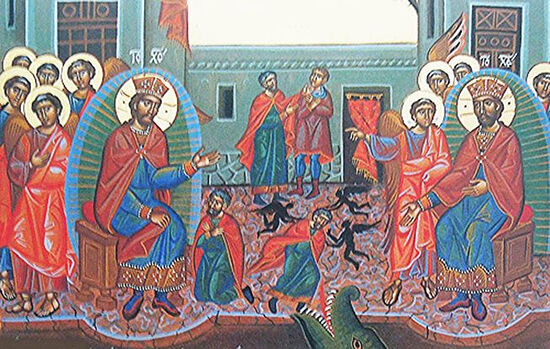
Sermon for the 20th Sunday after Trinity – The Parable parable of the unforgiving servant
The theme of forgiveness is emphasized in the Gospels, in which Christ teaches us by His example and His instructions why it is important that we forgive one another. Christ knows that it is difficult for fallen human nature to forgive, and therefore He confronts us with the truth that all of us are debtors to God and that we need His forgiveness. We acknowledge this every time we pray the Lord’s Prayer. When we say the words, “Forgive us our debts,” we are saying much more than a prayer. These words are also our confession in which we admit that we are sinners, that is, that our sins committed against God are our debts. They are a serious obstacle between us and God. With our sins we offend Him. And an offense against God requires punishment and restitution. Therefore, we are debtors to God who should repay the offense we commit against Him through our sins. If the debt is not settled, punishment will come upon us.
Unfortunately, we cannot free ourselves from the burden of debt to God, which we accumulate every day. But God does not leave us without comfort. Blessed is the truth that God forgives our sins. In fact, He took all our debts upon Himself when He died on the Cross.
Just as God forgives us through Christ, so we must forgive others. “If you forgive,” Christ says, “you will also be forgiven. But if you do not forgive, neither will you be forgiven” (see Matt. 6:14–15). And without God’s forgiveness, we cannot enter the Kingdom of God. Therefore, the question of our forgiveness toward our neighbor is, in fact, also a question of our eternal life.
Christ’s disciple, the holy apostle Peter, understood that he needed to forgive others, but—like many of us—he wanted to know whether there is a limit to forgiveness. How far should forgiveness go, how many times should we forgive? So the apostle Peter asks Christ: “Lord, how often shall my brother sin against me, and I forgive him? Up to seven times?” Jesus said to him, “I do not say to you up to seven times, but up to seventy times seven” (Matt. 18:21–22). The Pharisees and other devout Jews held to the rule that one should not forgive more than three times, following the words of the Lord repeated in the first two chapters of the prophet Amos: “For three transgressions… and for four… I will not turn away the punishment.” The apostle Peter wanted to show Christ that he was ready to forgive far more than three times. Seven is also the number of perfection, so forgiveness up to seven times would be perfect. But Christ responds: not seven, but seventy times seven, which at that time was a phrase meaning “without limit.”
In the continuation of His answer, Christ told the parable of the merciful king and the unmerciful servant, in order to show how great the forgiveness is that God gives us, and how unjust we often are toward those who owe us far less than we owe God.
A king once had a servant who owed him ten thousand talents. A talent was the largest unit of measure, and ten thousand the largest Greek number. It is known that in Christ’s time, the annual tax revenue of Palestine was about 600 talents. A denarius was the average daily wage. We do not know how the servant incurred such a debt. Let us assume that he had received a loan from the king. The king surely had enormous trust in this servant if he lent him such a sum. When the time came to repay the debt, the servant found himself in a difficult situation. He simply did not have the money. The king ordered, according to the legal customs of that time, that everything the servant owned be sold, even his wife and children, in order to settle the debt. But the servant desperately begged for mercy: “Master, have patience with me, and I will repay you all.” Although he optimistically promised repayment, the king knew the promise was unrealistic. Yet the just king showed mercy: “The master had compassion on that servant, released him, and forgave him the debt.”
After his debt had been forgiven, the servant met one of his fellow servants who owed him one hundred denarii. One talent was worth six thousand denarii. Thus, the debt of his fellow servant was 600,000 times smaller than the debt he himself owed the king—who, after his desperate plea, had forgiven him. Yet, despite this, the unmerciful servant demanded payment from his fellow servant, who also begged for patience. The Gospel tells us that he even used physical force: “he seized him and began to choke him.” He refused to show mercy, and instead had him thrown into prison until he could repay the debt—making repayment even more impossible, since the man in prison could not work.
Here we see the relationship between a king and a servant, and the relationship between two companions. The relationship between a king and a servant is formal and hierarchical, yet the king shows mercy. The relationship between two companions should be more intimate, informal, marked by greater mutual understanding. But the servant attacks his companion and shows no mercy. Therefore, Scripture tells us that one who claims to love God whom he has not seen, but does not love his neighbor whom he sees, speaks falsely (1 John 4:20).
The friends of the imprisoned debtor, saddened by the behavior of the forgiven servant, reported it to the king. The king summoned him and, angered by his behavior, said: “Should you not also have had mercy on your fellow servant, just as I had mercy on you?” And he handed him over to the torturers until he repaid all he owed.
The king represents God. The servant represents us, who are debtors to God, and the fellow servant represents our neighbors. The debts represent the offenses of our sins against God and the offenses that others commit against us. This is not about material debts—lest someone think Christians must be endlessly exploited by lending and forgiving money. Certainly, Christians should help others according to their abilities. But we should not be naive or allow ourselves to be exploited. From St. Peter’s question, it is clear that the issue concerns the sins of our neighbors against us.
The offenses we endure from others are incomparable to the offenses we commit against God. The just God knows that we cannot pay our debt. Christ came to this world to take upon Himself the sins of the world on the Cross. Justice was satisfied because Christ took our guilt upon Himself. For Christ’s sake—for His sacrifice, for His mercy—our sins are forgiven. We need forgiveness daily because we sin daily. But every time we come to Him in repentance, asking mercy and confessing our sins, God graciously forgives.
However, when it comes to forgiving our neighbors, we often forget how much forgiveness we ourselves have received from God—and not only from God. Many times our neighbors have forgiven our intentional or unintentional sins against them. St. Nikolai Velimirović writes: “Oh, if we only knew how much is silently forgiven us every day and every hour, not only by God but also by people, we would in shame hasten to forgive others! How many careless, offensive words we utter, answered only by silence; how many angry glances; how many improper gestures; even forbidden deeds! And people overlook these things, not returning eye for eye or tooth for tooth. And what can we say about God’s forgiveness? Every human word is insufficient. A divine word is needed to describe the immeasurable depth of God’s mercy and forgiveness.”
The king calls the unmerciful, ungrateful servant “wicked.” And this applies to all of us when we are unwilling to forgive others. The servant was wicked because he demanded justice from others, but for himself he sought mercy. We often behave this way toward God and our neighbors—we seek mercy from God but want our neighbors to receive what they “deserve,” forgetting that God does not cease to be just after He shows mercy to us. God loves us and requires us to love our neighbors. And we show love to our neighbors by being willing to forgive. St. Mark the Ascetic says: “The sign of sincere love is to forgive the wrongs done to us. With such love the Lord loved the world.” St. Paul says: “Owe no one anything except to love one another” (Rom. 13:8).
May God form within us the Christlike image of love and forgiveness toward our neighbors. Amen.
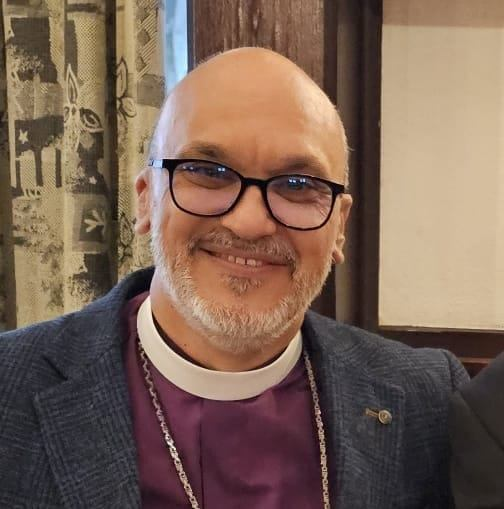
Rt.Rev. Jasmin Milić,Ph.D (Reformed Episcopal Church in Croatia and Serbia)
More about the Reformed Episcopal Church in Croatia and Serbia can be found here.


Discover more from Horizonti vjere
Subscribe to get the latest posts sent to your email.
