
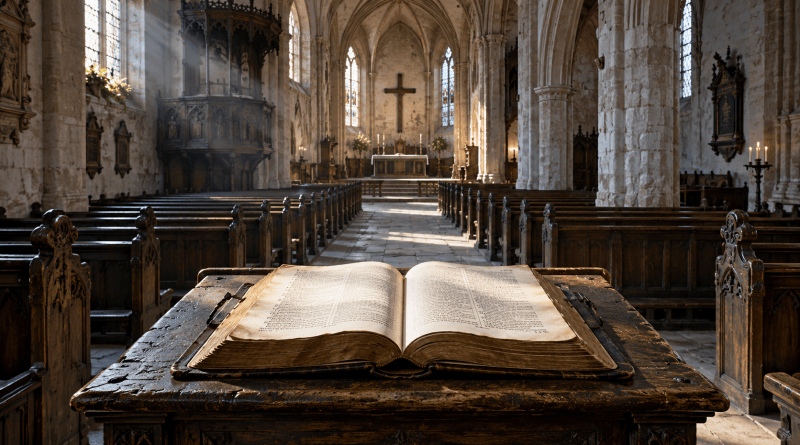
Protestantism Today: Reformation or Deformation?
By Bishop Jasmin Milić
The Protestant Reformation is traditionally associated with 31 October 1517, when Martin Luther posted his Ninety-Five Theses on the door of the Castle Church in Wittenberg. That event became a defining moment in a movement that sought to renew the Church and restore the integrity of its teaching and practice.
We often hear that Luther was angered by the deformation of the Church. Roman Catholic theologians and historians also acknowledge that numerous abuses within the Church had reached a critical point in the sixteenth century. The Church was crying out for reform and renewal. This was precisely what Luther wanted: to encourage reform within the Western Church. Sadly, that reform did not result in the restoration of unity. Instead, a division occurred. The Lutheran Church emerged under Luther’s leadership, the Reformed Church subsequently developed in Geneva under John Calvin, and Archbishop Thomas Cranmer led the reform of the Church of England, which had already separated from Rome.
Alongside these three historic expressions of the Reformation, Anabaptism emerged as its so-called radical wing. Later, particularly during the nineteenth and twentieth centuries, new communities arose and subsequently divided into numerous others—a process that has continued into the twenty-first century.
This brings us to the present landscape of Protestantism, which is undeniably confusing. When people ask what Protestants believe, how they worship, or how they understand the sacraments, the diversity of contemporary Protestantism—and of everything described as Protestant—makes a single, straightforward answer impossible.
Has Protestantism, as we know it today, succeeded in bringing about reform? Or has deformation taken the place of reformation within Protestantism itself?
The Church in Reformation Thought and Contemporary Practice
Let us begin with the Church. For the Reformers, there was no uncertainty on this point. They loved the Church, desired its renewal, and were prepared to give their lives out of love for it.
Although an unwanted division occurred, they did not regard their own churches—whether Lutheran, Reformed, or Anglican—as the only true Church. Rather, they understood them as parts of the one, holy, catholic—in the sense of universal—and apostolic Church. They regarded division as a tragedy and a temporary condition, pending the reform of the whole Church.
They taught a distinction between the “visible” and the “invisible” Church. The invisible Church consists of believers who truly belong to Christ and therefore to his body. The visible Church is the organised community expressed through particular churches, or what we would now call denominations. Yet, for the Reformers, one thing was clear: a person could not claim to belong to Christ and to the invisible Church while refusing to belong to a concrete, visible church in a particular place and time.
Today, however, increasing numbers of people who claim to uphold Protestant or Reformation principles argue that membership in the visible Church is unnecessary, or even sinful. When asked, “Which church do you belong to?” they reply, “Christ’s,” referring, of course, to the invisible Church. Their slogan is: “Christ, yes; the Church, no.” “The Church is religion,” they say, “and Christianity is not a religion.”
We cannot belong to Christ without belonging to the Church. The Church is his body! We cannot claim to belong to the universal or invisible Church while refusing to belong to a particular Christian fellowship in which the Church finds concrete expression.
This is not the teaching of the Reformation. It is a deformation for which those parts of Protestantism that have failed to teach a sound doctrine of the Church bear responsibility.
A Christian loves the Church and cares about every part of it, across the denominations that belong to Christ’s one universal Church.
The Sacraments in Reformation Thought and Contemporary Practice
Although the Reformers recognised two sacraments—without simply discarding all the other rites, to which they assigned different meanings or names—they reformed rather than deformed sacramental teaching.
For the Reformers, the Church is found “where the Word of God is preached and the sacraments are duly administered.” Baptism and the Eucharist therefore occupy an important place in early Protestant theology. The sacraments are God’s action, not ours. They are “an outward and visible sign of an inward and spiritual grace.”
For this reason, baptism is a sacrament that cannot be repeated. Where God acts, we cannot call into question the validity of the sacred sign and mystery. To deny the baptism of those who have been baptised in another Christian denomination with the proper intention, in the name of the Father, the Son, and the Holy Spirit, is not reformation but deformation.
For the Reformers, the Eucharist meant the real presence of Christ. They rejected the idea of a material transformation, yet understood Christ to be truly present in the Eucharist in a spiritual—or, more precisely, sacramental and mysterious—manner. Reducing the Eucharist, or the Lord’s Supper, to a mere memorial, recollection, or commemoration, as some contemporary churches claiming a Reformation heritage do, was condemned by the Reformers as heresy. This is not Reformation teaching. It is a deformation of both the ancient faith concerning the Eucharist and the Reformation’s teaching on this important Christian sacrament.
Arbitrary Interpretation of the Bible Apart from the Church
The Reformers placed the Bible in the hands of the people. They translated it into the vernacular so that everyone could become acquainted with the message of God’s Word. Yet they did not believe that everyone was qualified to interpret the Bible.
Many have misunderstood the Reformation teaching on the “priesthood of all believers.” It does not mean that the Reformers abolished ordained ministry and the Church’s teaching authority, or believed that everyone could interpret and preach the Scriptures. Rather, the priesthood of all believers means that all of us have access to God in prayer, confession, and the other dimensions of the Christian life, without requiring priestly mediation as it had been understood before the Reformation. Access to God is open to us all. Nevertheless, the Church’s ministries remain. The authoritative interpretation and teaching of God’s Word belong to those who have been called to that ministry and prepared for it through academic and spiritual formation.
The consequences of the idea that everyone may interpret the Bible independently are clearly visible today. Hundreds and thousands of different Christian sects have emerged as a result of this distorted understanding of the Reformation. What we are witnessing is a terrible and painful deformation of the body of Christ.
Liberal Theology: A “Child” of Protestantism
Some historic Protestant denominations have become leading advocates of so-called liberal theology. Much of this theology originates in Protestant theological faculties that, instead of preparing people for ministry in the Church, have effectively become secular institutions bearing a theological name. Their students obtain degrees in theology without becoming theologians in the fullest sense. Some openly identify as atheists, others as agnostics, and still others as liberal theologians.
Such “theologians” reject basic Christian doctrines grounded in Holy Scripture, including the virginal conception of Christ, the resurrection, Christ’s second coming, and eternal life.
While the Reformers fought for the purity of the gospel’s teaching—hence the designation “evangelical”—some contemporary Protestants lead the way in rejecting biblical truths as outdated, while describing themselves as progressive.
This is not reformation. It is a grave offence against the Reformation’s fundamental teaching concerning the Word of God. It is a serious deformation.
Some liberal theologians, despite serving as deans or professors at theological institutions, appear to have no need for the Church themselves. They do not attend Sunday worship or receive the Eucharist—or do so only rarely—yet they teach the Church’s future ministers. What an absurdity, and what a deformation.
How many public figures today promote liberal ideas while presenting themselves as theologians? Many hold degrees from Protestant or evangelical theological institutions.
Christian Morality and Ethics
Many values have been redefined within the secular societies of the twentieth and twenty-first centuries. Society increasingly advocates LGBT rights, including the right to marry and adopt children.
Secular society is, of course, entitled to advocate such positions, just as individuals have the right to choose how they live. We may agree or disagree, but we must not deny anyone their rights. The problem arises when society seeks to change biblical and Christian teaching. The Bible is clear about the union of two people in marriage: it is a union between a man and a woman. According to Scripture, sexual relations belong within the union of one man and one woman that we call marriage.
Yet some historic Protestant churches are among the strongest advocates of same-sex marriage and the admission of people in such relationships to ordained ministry. Furthermore, many historic Protestant churches advocate a right to abortion.
These positions do not reflect the spirit of the Reformation. They represent a serious deformation of Christian and Reformation teaching concerning the human person, the family, and life.
Whatever changes occur in society, and whatever rights individuals possess within it, the Church must remain faithful to the teaching of Holy Scripture.
Abandoning the Proclamation of the Gospel
This sounds strange indeed. Is it possible that such a thing could happen among Protestants, whose predecessors were once prepared to die for the Word of God? Sadly, it is. Wherever the door is opened to liberal theology and practice, and wherever the Church’s work is reduced to activism at the expense of evangelism, the proclamation of the gospel disappears.
Where the gospel is no longer proclaimed, the doctrine of salvation is also relativised. Christ is no longer preached as the only way to God. Yet one of the Reformation’s central principles was Solus Christus—Christ alone.
This is a serious deformation that continues to spread within Protestantism.
A Deformed Church Falls Apart
The Church of Christ has endured and will endure until his coming. Yet those parts of the Church that become deformed will fall apart. This is all too evident in our own time. Historic Protestant churches in Europe that embrace liberal theology and practice are losing members. Many parishes are disappearing. These are tragic consequences of deformation taking the place of reformation.
Ad Fontes: Let Us Return to the Sources
The Reformers called for ad fontes: a return to the sources. They did not reject all the beliefs and practices that had preceded them. Where the Church had become deformed, however, it needed to be reformed. Returning to the sources meant returning to the Bible, the early Church, and its teaching. It meant recovering ancient teaching, rather than inventing something new.
In response to contemporary deformations, new movements and teachings emerge, supposedly seeking to bring about another reformation. Yet, besides contributing to the further fragmentation of Christ’s body through new divisions and sectarianism, they introduce teachings without foundation in either Scripture or the early Church, thereby producing further deformations.
One such movement is “The Last Reformation,” founded by Torben Søndergaard of Denmark, whose teaching has increasingly spread into our region. Anyone who examines this teaching seriously will recognise what I regard as a profound distortion of the gospel, dangerous psychological manipulation, and a serious deformation.
The Reformation is not a call to a new doctrine or a new morality. Let us return to the sources, to that beautiful “old-time religion” of which a familiar Christian hymn speaks. The manner in which we proclaim the gospel can and should be renewed and adapted to the times in which we live. The substance of that proclamation, however, must remain unchanged. When we alter its substance, we deform biblical and Christian teaching.
Conclusion
Other deformations within Protestantism could also be named, but these examples are enough to make us pause and ask: where does Protestantism stand today? Protestantism is facing a serious crisis, and significant parts of it have undergone profound deformation. It is time to return to the sources and truly become the Church in which the Reformers believed. I fear that, if the Reformers could see what has happened to the churches of the Reformation, they would be deeply disappointed.
May the legacy of the Reformation encourage us to return to the “old faith”—the faith of Holy Scripture—and to reject the deformations that, sadly, characterise so much of contemporary Protestantism.
Discover more from Horizonti vjere
Subscribe to get the latest posts sent to your email.
