
“At Thy Word I Will Let Down the net” – Lk 5:1-11 – The Fifth Sunday after Trinity
The Gospel – St. Luke 5.1-11
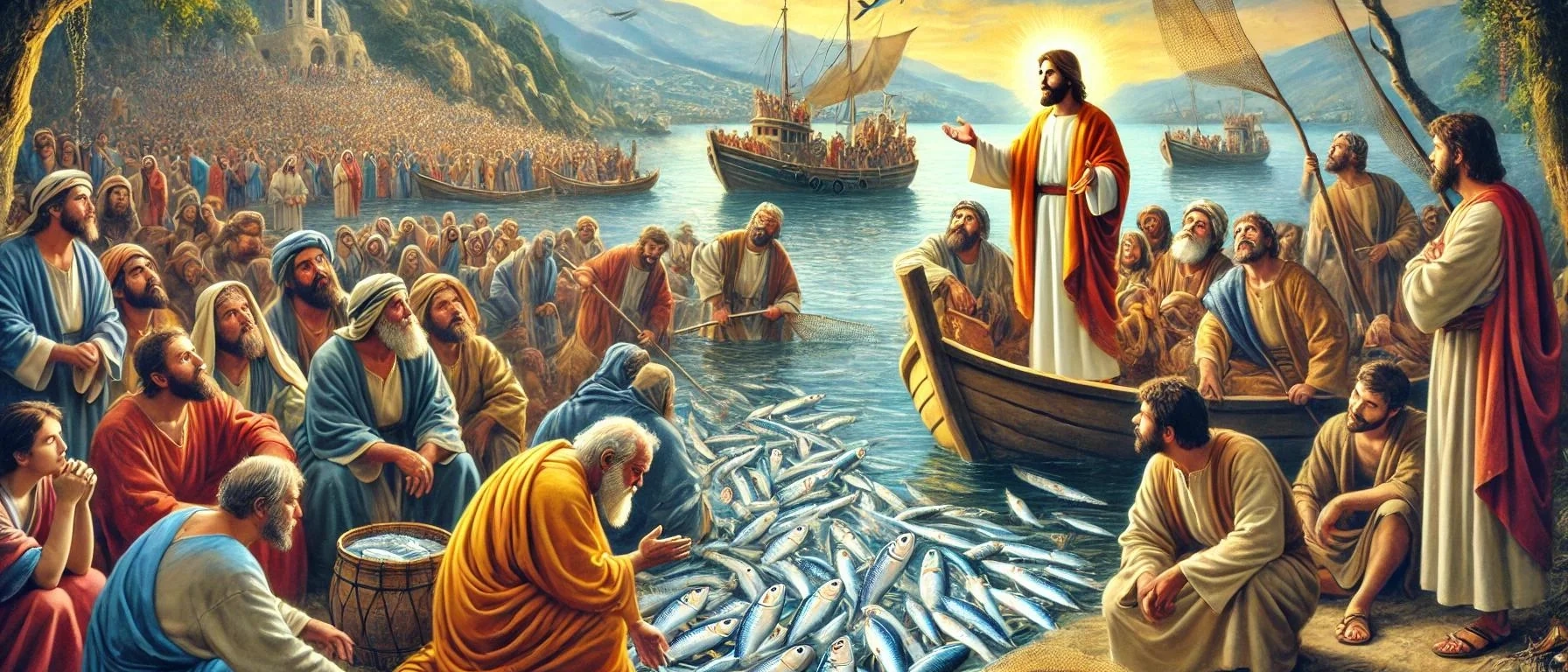
It came to pass that as the people pressed upon him to hear the word of God, he stood by the lake of Gennesaret, and saw two ships standing by the lake; but the fishermen were gone out of them, and were washing their nets. And he entered into one of the ships, which was Simon’s, and prayed him that he would
thrust out a little from the land: and he sat down, and taught the people out of the ship. Now when he had left speaking, he said unto Simon, Launch out into the deep, and let down your nets for a draught. And Simon answering said unto him, Master, we have toiled all the night, and have taken nothing; nevertheless, at thy word I will let down the net. And when they had this done, they inclosed a great multitude of fishes, and their net brake.
And they beckoned unto their partners which were in the other ship, that they should come and help them.
And they came, and filled both the ships, so that they began to sink. When Simon Peter saw it, he fell down at Jesus’ knees, saying, Depart from me, for I am a sinful man, O Lord. For he was astonished, and all that were with him, at the draught of the fishes which they had taken; and so was also James, and John, the sons of Zebedee, which were partners with Simon. And Jesus said unto Simon, Fear not, from henceforth thou shalt catch men. And when they had brought their ships to land, they forsook all, and followed him.

The Collect
Grant, O Lord, we beseech thee, that the course of this world may be so
peaceably ordered by thy governance, that thy Church may joyfully serve thee
in all godly quietness; through Jesus Christ our Lord. Amen. (BCP)
“At Thy Word I Will Let Down the Net” – Obedience to the Word of God
The people gathered around Christ on the shore of the Lake of Gennesaret, also known as the Sea of Galilee, which in the Gospels is sometimes referred to as the Sea of Tiberias due to its size. There were two boats there, from which the fishermen had come out to wash their nets after an unsuccessful night of fishing. Christ enters one of the boats, Simon’s, and from it He preaches to the gathered multitude. Simon’s boat becomes the pulpit of the Messiah and God-Man. Christ needs Simon—He needs a man as a co-worker in the mission of the Gospel. It is Simon, later named Peter, who will become one of Christ’s chief apostles. Although He called and sent out the apostles in a unique way, the Lord also desires to enter into our boats—our lives—that He might proclaim the Gospel from them. If we are in fellowship with Christ, then our lives must become a living sermon for Him.
The crowd was, as it were, “pressing upon him to hear the word of God.” Often in the Gospels we read of people seeking Christ for healing or some other miracle. Even today, many remember God only when they are in need. But how many hunger for the Word of God? Some of those who had eaten of the five loaves and two fishes later demanded another miracle from Christ. When He refused to satisfy their request, they turned away from Him. Then Jesus asked His disciples if they too would go away, and Peter replied:
“Lord, to whom shall we go? thou hast the words of eternal life.”
(John 6:68, KJV)
The prophet Amos says:
“Behold, the days come, saith the Lord GOD, that I will send a famine in the land, not a famine of bread, nor a thirst for water, but of hearing the words of the LORD.”
(Amos 8:11, KJV)
People today are spiritually hungry. They try to feed themselves at various tables that cannot satisfy the hunger of the soul. The only One who can fill that emptiness, who can nourish the soul, is Christ.
Why do we need God? Merely to respond to our personal needs, or because we desire fellowship with Him—to listen to His Word, to live by it, and to bear witness through our deeds? Let us remember the young Samuel who answered the Lord’s call:
“Speak; for thy servant heareth.”
(1 Samuel 3:10, KJV)
To speak of hearing the Word of God is to speak of obedience. The Lord desires us to believe His Word and act accordingly. After He had finished preaching, Christ told Simon and the other fishermen with him—James and John, the sons of Zebedee—to obey Him:
“Launch out into the deep, and let down your nets for a draught.”
(Luke 5:4, KJV)
Christ was not asking them to do anything they hadn’t done many times before. But this time, He was asking them to do so after a failed night of fishing. They were likely tired and discouraged. Simon told Christ plainly that there was no point in it:
“Master, we have toiled all the night, and have taken nothing: nevertheless at thy word I will let down the net.”
(Luke 5:5, KJV)
How many times do we find ourselves in similar situations? We are told to pray, to trust God regardless of our circumstances, yet we feel that our prayers are in vain. We’ve prayed many times, and God didn’t respond the way we wanted. This can lead us to question whether prayer—or faith itself—is meaningful. We may think, “We tried, but it didn’t work.” Behind such thoughts is Satan, who seeks to discourage us on our journey of faith.
Simon, even while expressing doubt, is willing to obey Christ’s word:
“Nevertheless at thy word I will let down the net.”
Was Simon perhaps hoping that Christ would see for Himself that the nets would catch nothing? We might interpret his words this way: “Master, we’ve fished all night with no success. If the night didn’t yield results, neither will now. But if You insist, I’ll cast the net so You can see I’m right.” Such a scenario is not impossible. We can find ourselves in the same mindset—praying as a formality, not truly expecting God to answer. We might even ask, “Where are You, God?” and indirectly accuse Him of neglect. We do everything right—we pray, fast, attend church—but God doesn’t respond as we expect.
The more likely scenario, however, is that Simon acted in obedience. Despite his expertise in fishing, he chose to obey Christ’s word. In their own strength and skill, the fishermen had failed. But at Christ’s command, they act—and obedience bears fruit. So many fish were caught that the nets began to break. The fishermen in the other boat came to help. Both boats were filled to the point of sinking. When we obey Christ with faith, the response will not be lacking.
When Simon realized that he should trust the word of Christ rather than his own knowledge or ability, the miracle occurred. Our hearts are often closed to the Lord and His Word because we think we know enough, that we’re capable of managing on our own. But life often proves otherwise. Then, like King Jehoshaphat of Israel, we must confess:
“For we have no might against this great company that cometh against us; neither know we what to do: but our eyes are upon thee.”
(2 Chronicles 20:12, KJV)
When we confess our weakness before God and listen to His Word, we will witness His mighty works in our lives. When we confess our inability, He will give us His strength.
In this miracle, Christ teaches a spiritual lesson about trusting His Word, but also shows care for human needs. The fact that the fishermen had caught nothing affected their livelihood—they lived from fishing and fed their families with it. Just as He miraculously fed five thousand, Christ here shows that He will not leave us without daily bread. He, who cares for the birds of the air and the lilies of the field,
“Behold the fowls of the air… Consider the lilies of the field…”
(Matthew 6:26–28, KJV)
will care for our daily needs as well.
“When Simon Peter saw it, he fell down at Jesus’ knees…”
(Luke 5:8, KJV)
It is noteworthy that Peter is sometimes called by both his old and new name: Simon Peter. “Simon” was his birth name, meaning “to hear” or “God has heard.” “Peter,” given by Christ, comes from the Greek petros, meaning “rock.” Simon represents the old man, the man before Christ; Peter represents the new man in Christ. But he is often referred to as Simon Peter—both the old and new man. While we are still in this body, we are both Simon and Peter—sometimes more one than the other. Which nature prevails depends on our obedience to God. A priest once asked his congregation, “How do we kill the old man within us?” An elderly woman answered, “Don’t feed him, and he’ll die.” In that simple reply lies a profound truth. Whichever man we feed within us—that one will live.
“Depart from me; for I am a sinful man, O Lord.”
(Luke 5:8, KJV)
In this miracle, Christ reveals His omniscience and power. He reveals Himself as God. Peter acknowledges this and falls before Him, confessing his sin and addressing Jesus not just as Teacher, but as Lord. Before, Peter had said “Master”; now he says “Lord.” Opponents of Christ’s divinity often say He never called Himself God. But Christ didn’t have to—His works testified of Him. Peter acts like the Old Testament prophets who, in the presence of God, felt unworthy. The prophet Isaiah said:
“Woe is me! for I am undone; because I am a man of unclean lips…”
(Isaiah 6:5, KJV)
Jeremiah felt the same before the Lord:
“Ah, Lord GOD! behold, I cannot speak: for I am a child.”
(Jeremiah 1:6, KJV)
Likewise, Peter, in the presence of Christ, recognizes his sin and confesses Jesus as Lord and God.
Christ then says to Simon:
“Fear not; from henceforth thou shalt catch men.”
(Luke 5:10, KJV)
The Lord used simple fishermen for great tasks. Simon, James, and John were entrusted with a high calling, which would involve many challenges, doubts, and fears. That is why Christ spoke the words: “Fear not!”
Fear is a natural human emotion. Sometimes it is justified and protects us from danger. In that sense, we understand the concept of “fear of the Lord,” which we should cultivate. But often we experience fears that paralyze us and prevent us from facing our circumstances. St. John Chrysostom said:
“He who lives by the Holy Spirit stands above fears and troubles and dangers and every change, because he is not subject to any of them, but is—what is far more important—spiritually free from everything happening around him.”
In this miraculous catch of fish, Christ—as in other instances—demonstrates His authority over all circumstances. If we believe in such a Christ, what have we to fear?
In these words, Christ also reveals Himself as God. These are divine words that echo throughout the Old Testament whenever God encourages His people:
“Fear thou not; for I am with thee: be not dismayed; for I am thy God: I will strengthen thee; yea, I will help thee; yea, I will uphold thee with the right hand of my righteousness.”
(Isaiah 41:10, KJV)
We said at the beginning that Christ needs man. Simon, James, and John leave their boats and “follow Him.” Others were there, but their names are not mentioned. Though they saw the miracle, they were not ready to leave everything and follow Christ. Many today fear leaving “everything”—their old lives—to follow Him. They fear loss, like the rich young man who could not part with his wealth to follow Christ. But with Christ, we do not lose—we gain, both in the life to come and in this present life.
In the Prayer before the Gospel in the Liturgy of St. Mark, we pray:
“Master, send forth Thy light and Thy truth, and enlighten the eyes of our minds to the understanding of Thy divine words, and make us worthy to be not only hearers, but also doers of the word, bringing forth good fruits…”
Likewise, in the Liturgy of St. James we pray:
“O God, who hast taught us Thy divine and saving words, enlighten the souls of us sinners to receive what has been read, not as mere hearers of spiritual sayings, but as doers of good deeds…”
May God help us to be obedient to His Word, to rely not on our own knowledge, ability, or strength, but on Christ—who makes the impossible possible, to the glory of His name. Amen.
Author: Bishop Jasmin Milić
