
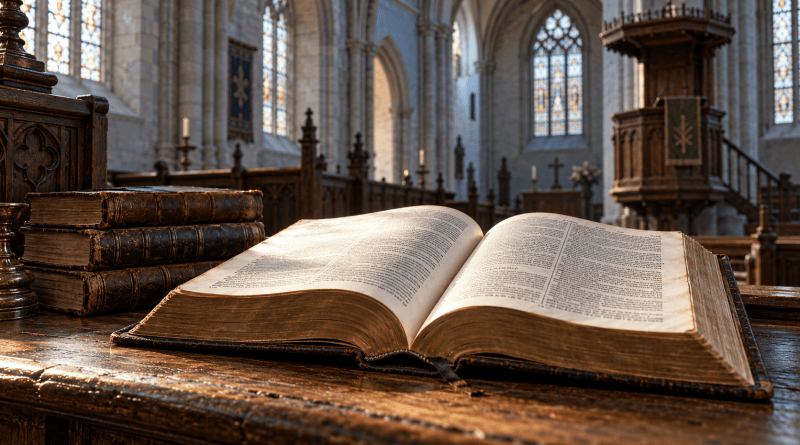
Do Protestants Really Follow the Bible Alone? Understanding Sola Scriptura
This article examines Sola Scriptura primarily in the context of the Croatian Protestant scene, where non-traditional Protestant churches commonly describe themselves as Crkve reformacijske baštine (“Churches of the Reformation Heritage”). This local designation distinguishes them from historic Protestant churches, such as the Lutheran and Reformed churches. Against this background, I consider what “Scripture Alone” actually means—and whether the rejection of tradition reflects the teaching of the Reformers themselves.
One of the so-called five solas (“alones”) of the Reformation is Sola Scriptura, or Scripture Alone. This principle is particularly emphasised by churches of the Reformation heritage, which understand it to mean that their teaching is based solely and exclusively on the Bible, and that the Bible is the only standard for their teaching and practice. This understanding of Scripture Alone has resulted in differing interpretations of the Bible, giving rise to thousands of new communities, movements, sects, and similar groups. Since these groups often publicly identify themselves as Protestant, this can create the impression that Protestants lack seriousness in their understanding and interpretation of the Bible.
Churches of the Reformation Heritage
Let us briefly consider these churches and their insistence that the Bible alone governs their beliefs and practices. Is this actually the case? Generally, it is not.
Take Pentecostals, for example. They are dear and sincere believers who love God, bear witness to their faith, express their love for God with considerable emotion, and, of course, emphasise that the Bible is their sole authority. But what about the prophecies delivered during their worship services? According to Pentecostal teaching, as well as that of other charismatic Christians, some believers continue to possess the gift of prophecy today. Such a believer will often stand up during public worship and begin speaking in God’s name: “Thus says the Lord,” before delivering words that both the speaker and those present believe the Lord is speaking. Such a message matters to the congregation. The Lord is speaking, which means that this is God’s word and carries authority for the church or the individual.
Then there are Seventh-day Adventists, who have recently become increasingly open towards other Christian communities, thereby drawing closer to churches of the Reformation heritage. Adventists also like to emphasise that they are Protestants and that Scripture Alone is their principle. But is this genuinely reflected in their practice? It is not. Adventists have what they call the “Spirit of Prophecy,” associated with the writings of Ellen White, a prophetess who played a major role in shaping Adventism as we know it today. Adventists will say that Ellen White’s writings are a lesser light, but they are nevertheless a light, and her teaching remains highly significant for them.
It should also be noted that members of these generally younger communities frequently appeal to their own inherited teachings and traditions. Apart from Baptists, who emerged in the seventeenth century, most of the communities referred to here as churches of the Reformation heritage arose in the late nineteenth and early twentieth centuries. Among them, there is often a strong emphasis on preserving the beliefs, order, and discipline that characterised their communities at their beginnings.
Cults
Cults are particularly fond of insisting that their teaching is exclusively biblical. Yet their teaching is, in fact, far removed from the Bible, so they must seek justification for their beliefs in other sources. Jehovah’s Witnesses, for example, have The Watchtower and other publications through which their organisation communicates its teachings to its members. The Church of Jesus Christ of Latter-day Saints, more commonly known as the Mormons, has, in addition to the Bible, The Book of Mormon, Doctrine and Covenants, and The Pearl of Great Price. This is to say nothing of the authoritarian role of leaders and the authority their teachings carry within these cults.
Historic Protestant Churches
If the Bible is not, in practice, the sole authority for churches of the Reformation heritage, do the historic Protestant churches base their teaching solely and exclusively on the Bible? They do not.
All historic Protestant churches accept certain ecumenical councils, generally up to the first six, as well as the principal creeds: the Apostles’ Creed, the Nicene-Constantinopolitan Creed, and the Athanasian Creed. In addition, they have developed their own confessions, which define their teaching on the basis of both the Bible and the teaching of the early Church. Lutherans have the Augsburg Confession; the Reformed have the Heidelberg Catechism, the Belgic Confession, the Westminster Confession, and the Second Helvetic Confession; and Anglicans have the Thirty-Nine Articles of Religion.
Ad Fontes – Back to the Sources
The Reformers used this Latin motto, a common expression in their day, to call for a return to Christian sources. Did this mean returning to the Bible alone? It did not. For them, it was a call to return to the teaching of early Christianity: to the Bible and to those teachings of the early Church, handed down through tradition, that did not contradict Scripture.
Those who have studied the works of Martin Luther, John Calvin, Thomas Cranmer, and other Reformers will recognise how readily they quoted the Apostolic Fathers and the Church Fathers, and how frequently they returned to patristic writings. Precisely in order to defend their teachings, they appealed to the Apostolic Fathers and the Church Fathers of both East and West, as well as to the canons of particular councils. The early Reformers did not dismiss tradition as worthless. Their understanding of the Bible was that it is the only infallible source for our faith and practice.
Tradition is not infallible. Nevertheless, although it is fallible, the Church’s tradition—which encompasses the teaching of the Apostolic Fathers and the Church Fathers, the decisions of early church councils, and similar sources—has produced doctrinal formulations that the Church should accept insofar as they do not contradict Scripture.
For example, the doctrines of the Trinity and the two natures of Christ are not found in the Bible in their fully developed theological formulations. These were articulated during the early centuries of Christianity. Protestants have accepted these truths not merely because they belong to the Church’s tradition, but because they are consistent with the biblical revelation of God and Christ.
The Bible Is the Final Authority
It would therefore be unfair both to the Fathers of the early Church and to the Reformers to say that Protestants believe solely and exclusively what is explicitly written in the Bible. The Bible stands above everything else: Scripture Alone, understood in the sense that it is the final authority and definitive revelation, and that everything we believe which belongs to the foundations of Christian tradition must agree with its teaching.
This can be seen clearly in Protestant confessions. The Second Helvetic Confession, for example, teaches that the interpretations of the Greek and Latin Fathers, together with their discussions of sacred matters, should be valued insofar as they agree with Scripture (Chapter II).
Article VIII of the Thirty-Nine Articles of Religion states that the Nicene Creed, the Athanasian Creed, and the Apostles’ Creed are to be fully received and believed because they can be established from the sure testimony of Holy Scripture. This article makes it clear that these creeds, which form part of the Church’s tradition, are necessary expressions of the Christian Church’s faith because they agree with Holy Scripture.
What the Bible is indeed sufficient for is the revelation of salvation and of the truths that must be believed for our salvation, as stated in Article VI of the Thirty-Nine Articles.
Prima Scriptura – The Primacy of Scripture
Because Sola Scriptura is sometimes misunderstood, Anglicans and Methodists may speak of Prima Scriptura. This expression conveys what the Reformers themselves emphasised: that the Bible has primacy, or precedence, over all other sources of Christian faith and practice.
For Anglicans, these sources are Scripture, tradition, and reason, an approach associated with the sixteenth-century Anglican theologian Richard Hooker. In the theological approach associated with John Wesley, the eighteenth-century founder of Methodism, four sources are identified: Scripture, tradition, reason, and experience.
For both Anglicans and Methodists, however, the Bible remains the primary and only infallible authority for faith and practice.
The Church Predates the Christian Bible
We must be honest: the Bible, too, has been handed down through the Church’s tradition. The Church predates the Christian Bible in its completed form, comprising the Old and New Testaments.
Recognition of the twenty-seven-book New Testament canon we know today developed gradually. By the second century, many of its books were already widely recognised, while the earliest surviving list containing precisely these twenty-seven books appears in the writings of Athanasius of Alexandria in AD 367.
Thus, the Church, under the guidance of the Holy Spirit, as we believe, recognised and established the biblical canon. The Church existed before the completed Christian Bible. First came the handing down of the apostolic faith within the Church, and subsequently the completed New Testament canon, which, together with the Old Testament, constitutes the Christian Bible. For Protestants, this Bible is the only infallible and final authority.
Conclusion
The Reformers emphasised the Bible as the only infallible, primary, and final standard of Christian faith and practice. At the same time, they did not reject the contribution of tradition in matters that do not contradict biblical teaching. The Church’s tradition—the teachings of the Fathers, the early councils, the creeds, and similar sources—is valuable for defining Christian faith and practice. Yet it is not infallible and must be assessed in the light of Scripture.
Any claim by a Protestant church or a church of the Reformation heritage that it follows only the Bible in its beliefs and practices is therefore inaccurate. In addition to accepting much from the tradition of the early Church, including the canon of the Old and New Testaments itself, these churches also have their own confessions, canons, constitutions, regulations, and other rules to which their members are expected to adhere.
We should therefore understand the Reformation principle of Sola Scriptura in the sense in which the Reformers understood and defined it. They valued the contribution of the Church’s tradition wherever it agreed with Scripture, rejected teachings arising from tradition that contradicted Scripture, and thereby upheld the Bible as the final authority in the Christian Church.
Author: The Rt. Rev. Dr. Jasmin Milić Bishop of the Pannonian-Danubian Diocese of the Reformed Episcopal Church

Discover more from Horizonti vjere
Subscribe to get the latest posts sent to your email.
