
Weddings require invitations (Most Rev. Ray R. Sutton)
Most Rev. Ray R. Sutton
Trinity 19
Matthew 22:1-14
Reformed Episcopal Church, Tordinci – Croatia, October 14, 2023.
Weddings require invitations. The family invites their friends and loved ones. Not just anyone can come to a wedding. The invitation has to be accepted to come. It’s expected that those who come wear nice clothing to honor the Groom and Bride. It’s a special occasion.
Jesus teaches us in our Gospel today about the kingdom of heaven with the parable of a wedding and its feast. From it we learn an important, deep, covenantal lesson about a true relationship with Jesus Christ. But first let’s consider how this story fits into the message of St. Matthew’s Gospel. First, as for the context of St. Matthew’s Gospel, like each Gospel it has a unique revelation of the Incarnation of Jesus Christ. All the Gospels tell the same story but with different messages about Jesus Christ as the Messiah.
They do not contradict each other. The Bible is the inerrant, infallible Word of God. But the Gospel accounts each reveal how Jesus Christ is the Messiah fulfilling large Old Testament prophecies. St. Matthew presents how Jesus Christ fulfills the New Covenant by including Jew and Gentile through the Wisdom of God. The ancient prophets foretold how the Abrahamic covenant would expand to include Gentiles. But only the wisdom of God knew how and when. One of the ways they told of recognizing the Messiah who brought the New Covenant was through His great wisdom.
The Lord in the Old Testament even gave them a brief preview of the coming of a New Covenant for Jew and Gentile. It was at the time of the King Solomon the son of David. God told Solomon he could have one wish. Solomon asked only for wisdom. But he knew that with God’s wisdom he could have everything. God gave him wisdom. Much of it is revealed in the Book of Proverbs.
But through this wisdom, Gentile kings and queens came to Solomon. One of them was the Queen of Ethiopia. She was led to establish her kingdom on the Word of God. Solomon showed her how. As a Gentile she came into the kingdom of God. It is a sign of the New Covenant coming with the Messiah. Matthew’s Gospel reveals how Jesus Christ the Messiah fully accomplished this New Covenant by being the Wisdom of God.
St. Matthew reveals Christ’s wisdom by organizing his Gospel around five sermons of our Lord. He helps us to see this structure of his book. He provides the same verse at the end of each sermon. It is the words, “And it came to pass, when Jesus had finished these sayings” (7:28; 11:1; 13:53; 19:1; 26:1). Scholars call this kind of statement a literary marker for Christ’s sermons. They are called “sayings.” This is a word in the ancient world that refers to wisdom sayings.
Christ’s sermons are wisdom teachings that start with the greatest, wisest homily in the history of the world. It’s the Sermon on the Mount (Matthew 5-7). St. Matthew reveals something else about Christ’s sermons in his Gospel. They follow the themes of the first five books of the Bible. They are called the Pentateuch or Torah: Genesis, Exodus, Leviticus, Numbers, and Deuteronomy. Christ’s sermons expounds His fulfillment of the messages of the foundational books of Scripture. Then after His sermons the sections to follow relate the events of the life of Christ to the wisdom teachings of His sermons.
For example, Jesus’ first homily, the Sermon on the Mount, is about the blessing teaching of the Book of Genesis. Blessing is the favor of God on His promised chosen seed. Throughout the book, only those who live by faith receive the wisdom of the promises of God.
The second sermon in Matthew is Christ’s teaching for sending out His disciples (ch. 10). Christ sends His disciples to call all people into an Exodus out of the world, the flesh, and the devil. This sending to gather people out of the world is an Exodus. Christ the Messiah introduces a second Exodus in history.
The third homily begins in Matthew 13. It is a series of parables. They are wisdom stories. They are like riddles that only Christ can solve. They center around the imagery of seed as the Word of God. But this seed is contrasted with evil seed called weeds or tares. This is a theme from the third Book of Moses called Leviticus. It is about being holy or clean. One of the teachings about cleanness is not sewing two kinds of seed in one field (Leviticus 19:19). Only one seed makes the field clean or pure. Jesus in His parables speaks of how He and His Word are the true seed.
Jesus’ fourth homily in Matthew’s Gospel in Matthew 18 is about correcting a fallen disciple, church discipline. This is the same theme as the Book of Numbers, the fourth book of the Bible. The whole book is about the disciplinary lessons of Israel’s wilderness wanderings.
The final sermon of Christ in St. Matthew is the Mt. Olivet Discourse in chapters 21-25. Before Christ goes to Jerusalem to be crucified, He takes His disciples to the Mount of Olives to teach them. This lengthy sermon speaks of succession in God’s covenant. Succession has to do with His and the disciples future. This is called continuity and discontinuity with Christ. He tells how and which disciples stay in covenant with God. This is continuity. He also describes how and which of the Lord’s followers do not remain with Christ, the Son of God. Finally, He reveals in His last sermon that He will die. But His death will not mean discontinuity. Somehow it will bring continuity through His redemption. He will not remain dead. Succession in this world and the next only comes through Him.
Therefore, these chapters recording Christ’s sermon are like the Book of Deuteronomy. This was Moses’ last sermons before Israel entered the land. Except he died. He could not enter. Jesus would die but He would come back to lead His people. In this context of succession of the covenant is our passage about a wedding. It’s all about those who don’t come and those who come. This is continuity and discontinuity.
Second after considering the context of Matthew’s Gospel, let us look at the story. A king sends out invitations for his son’s wedding. The wedding involves a feast. The invitees fail to come for various reasons. These guests are unbelieving Jews who do not accept Christ as Messiah. The king sends out an army and judges them. This judgment took place at the fall of Jerusalem in A.D. 70. The king in the parable then invited a second list of guests to the wedding.
These guests come. They represent other Jews and even Gentiles. They come to the wedding. The message in one sense is the story of the Bible. God’s covenant is a marriage as found in Hosea 2. God is the Groom and His people are the Bride in both the
Old and New Testaments. There is a feast to seal and consummate this union with the Lord. Also in the parable is the message that to come to the wedding God’s invitation has to be accepted to enter His kingdom.
God’s invitation is accepted by grace through faith. This is the message of Jesus’ final sermon recorded in St. Matthew’s Gospel. The parable of the wedding and its feast introduces the sermon. Mt. Olivet Discourse. The rest of this sermon speaks of the need to answer God’s invitation and come to His wedding feast. Significantly, immediately after the Mt. Olivet sermon and the structural marker (26:1), Christ turns His disciples toward Passover (26:2).
At His Last Supper during Passover He introduces Holy Communion. Both Passover and the Blessed Sacrament are wedding feasts. They are the wedding feast of the parable. Passover was the marriage of God to Israel. The Prophet Jeremiah says that Yahweh became Israel’s “husband” at the Exodus (Jeremiah 31:32). This marriage started with Passover as a wedding feast. In the ancient world, two who wanted to be married offered sacrifice at the door of their house. They
dipped their hands in blood and put their prints on the door posts. They then crossed or passed over the threshold to eat the sacrifice. God’s Passover was a wedding. This is what happened at Passover. A lamb was sacrificed. His blood was put on the doorpost of the threshold to the house. Entry was by crossing over the blood of the sacrifice. Then the lamb was consumed in the Passover Supper. The marriage to God was sealed in the communion meal.
At the Last Supper, Jesus introduced His Holy Communion in the context of the Passover as a wedding feast. His Eucharist became the fulfillment of a spiritual nuptial union and communion with Christ. It is consummated by sacramental food. Only, in the Lord’s Supper Christ is the Lamb of God who mystically comes to us by faith in this Sacrament. The New Testament calls this sacred meal the “Marriage Supper of the Lamb.” It is a Holy Feast participating in Christ’s sacrificial death on the cross. Jesus says of the cup of wine, “This is My blood of the covenant, which is poured out for many for the forgiveness of sins” (Matthew 26:28). This language of “pouring” out speaks of Christ’s sacrifice on the cross. St. Paul says the Eucharist “proclaims Christ’s death until He comes” (1 Corinthians 11:26).
Therefore, St. Augustine referred to Christ’s Passion at Calvary as the “marriage bed of the cross.” That is, the death of Christ consummated His salvation of the world. He said, “It is finished,” or “consummated.” Martin Luther used the image of the “wedding ring of faith.” Christ’s parable reveals that only those who accept God’s invitation can be part of His Son’s wedding.
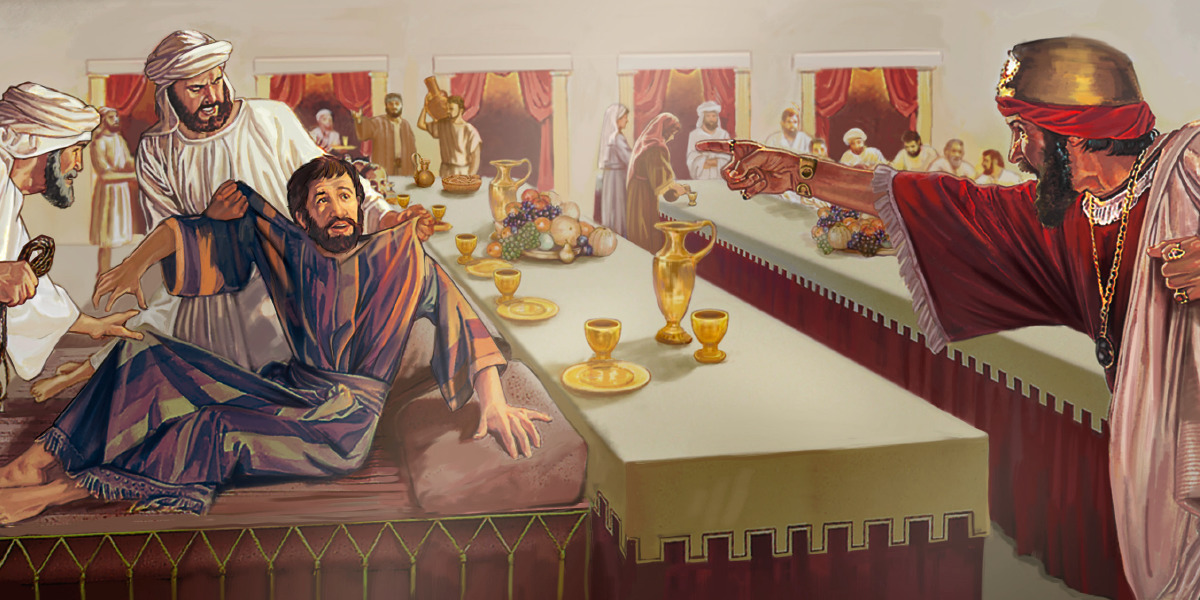
But there is one more part to the story telling about our entrance into God’s kingdom. One man tries to enter without a wedding garment. In ancient Jewish weddings, all the guests had to put on a clean wedding garment to enter. Their regular cloths were dirty and not fit to be worn on a glorious occasion. They needed a clean, special garment to attend the wedding.
The man in the story refused. He was not allowed to enter. And he was judged. This part of the story teaches an important covenantal lesson. Covenants in the Old Testament often involved an exchange of a piece of clothing. This was a way of showing oneness in covenant with each other. David made covenant with Jonathan this way (1 Samuel 18:3-4). By putting on each other’s cloak, they made a covenant with one another. They became one in God by means of their clothing exchange. The New Covenant continues this concept. St. Paul speaks of walking in God’s covenant as “putting off” the works of the flesh and “putting on” Christ. He tells the Ephesians to “put on the New Man” (Ephesians 4:24). Christ is the “New Man” they are to become. He says the same to the Galatians.
He even speaks of Holy Baptism as “putting on Christ” (Galatians 3:26-29). “Putting off” and “putting on” is the covenant language. The man in Christ’s parable had not “put on” the wedding garment of cleansing. This symbolized not “putting on” the cleansing of Christ. It is analogous to trying to enter the Church without baptism. It is where we put on Christ by faith.
Therefore, our parable reveals how the new wedding guests of the Gentiles come to the marriage of Christ the Son to His Church. They must put on Christ by faith and be baptized. The same is for us. We become clothed by Him by faith and baptism. We become united to Him in oneness. As our Scripture and our liturgy say, “He in us and we in Him.” May God give us grace to see this wisdom. Amen.
Most Rev. Ray R. Sutton
See this:
Discover more from Horizonti vjere
Subscribe to get the latest posts sent to your email.
