
The Parable of the Pharisee and the Publican – Lk 18:9-14 – The Eleventh Sunday after Trinity
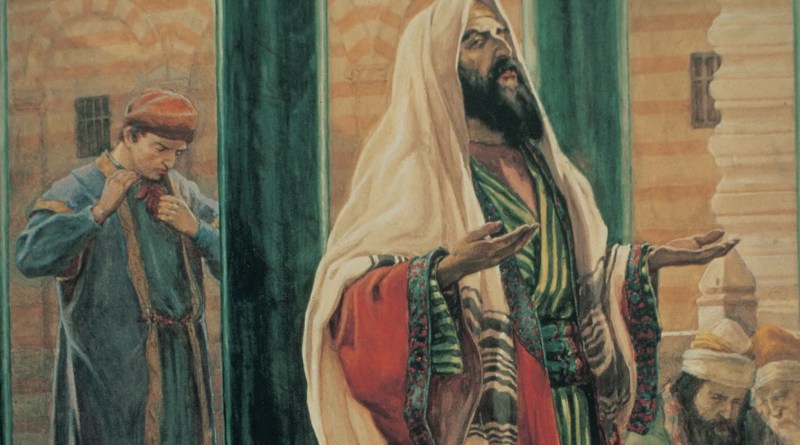
In The Parable of the Pharisee and the Publican, in Luke 18:9–14, Jesus contrasts a self-assured Pharisee with a contrite publican praying in the Temple. The Pharisee boasts of his virtues, while the publican, standing afar off, smites his breast and pleads, “God be merciful to me a sinner.” Christ declares the penitent man “went down to his house justified,” teaching that “every one that exalteth himself shall be abased; and he that humbleth himself shall be exalted.”
The Eleventh Sunday after Trinity
The Collect:
O GOD, who declarest thy almighty power chiefly in showing mercy and pity; Mercifully grant unto us such a measure of thy grace, that we, running the way of thy commandments, may obtain thy gracious promises, and be made partakers of thy heavenly treasure; through Jesus Christ our Lord. Amen.
The Gospel:
JESUS spake this parable unto certain which trusted in themselves that they were righteous, and despised others: Two men went up into the temple to pray; the one a Pharisee, and the other a publican. The Pharisee stood and prayed thus with himself, God, I thank thee, that I am not as other men are, extortioners, unjust, adulterers, or even as this publican. I fast twice in the week, I give tithes of all that I possess. And the publican, standing afar off, would not lift up so much as his eyes unto heaven, but smote upon his breast, saying, God be merciful to me a sinner. I tell you, this man went down to his house justified rather than the other: for every one that exalteth himself shall be abased; and he that humbleth himself shall be exalted. St. Luke 18:9-14

Sermon: The Parable of the Pharisee and the Publican – Lk 18:9-14 – The Eleventh Sunday after Trinity
In the parable before us we see a religious man—the Pharisee—who believes he possesses all the virtues that adorn a devout man, and a publican who is aware of his sinfulness and sincerely repents of his sins.
Before telling this story, Christ said to whom it was addressed: “And he spake this parable unto certain which trusted in themselves that they were righteous, and despised others” (Luke 18:9). The Pharisees undoubtedly regarded themselves as more righteous and religious, more honest, more spiritual, and purer than other believers. But Christ does not address this story to them only; it is for all who in every age have the same problem of self-righteousness—including today’s “modern Pharisees,” who exalt themselves and belittle others.
The scene takes place in the Temple. There is nothing unusual about a Pharisee being in the Temple; the Pharisees were the spiritual elite of their day and enjoyed a certain esteem among the people. What is unusual is that a publican is found in the Temple. They were considered traitors to their nation, dishonest men and thieves—in other words, great sinners. Many in that time were convinced that publicans could not be pious and therefore had no place in the Temple. This attitude is still present among many modern “Pharisees.”
How often have we heard very pious people express outrage when they see in church someone whom they believe does not belong there. Yet there is no better place for a sinner than the church, at public worship; there the sinner meets the living God, before whom he becomes conscious of his sin and of God’s mercy.
Once a devout Christian woman came to the church and said to the pastor, “I hear you receive sinners,” focusing especially on certain people she thought did not belong in church. He replied, “Yes, that is true. There is room for you as well—welcome.”
The Pharisee stood and proudly gave thanks to God, listing the sins he did not commit and asserting that he was not corrupt like other men. Since a publican was present, he especially thanked God that he was not like him. As Scripture says, “The Pharisee stood and prayed thus with himself, God, I thank thee, that I am not as other men are, extortioners, unjust, adulterers, or even as this publican” (Luke 18:11). How many times have we reacted in just this way! We love to compare ourselves with others, especially with those we consider ourselves superior to—spiritually and in every other sense.
How often have we heard people excuse their absence from church on the ground that they are better than those who attend? Whenever we humiliate others, we do it in order to exalt ourselves. We often hide our own sins while pointing out the sins of others. We may manage that somewhat before people, but we cannot deceive God. And that is exactly what the Pharisee attempted. His posture actually revealed disrespect toward God.
Having introduced himself to God as a highly moral person, the Pharisee went on to boast of his religious merits: “I fast twice in the week, I give tithes of all that I possess” (Luke 18:12). Pious Jews fasted twice weekly, on Mondays and Thursdays, though such fasting was not commanded as an obligation. And as to tithes, the Pharisee did more than was required; the Law prescribed tithing certain grains, yet he tithed “of all” he acquired.
In contrast to the Pharisee, who prays standing and looking toward heaven (the customary posture of prayer), the publican stands afar off, not lifting his eyes to heaven because he counted himself unworthy. He smote upon his breast—a sign of sorrow. True repentance includes grief for the sins we have committed, for by them we have offended God Himself. The Pharisee looked down on the publican, but the publican knew he stood before the very God whose mercy he needed. Therefore he simply prayed: “And the publican, standing afar off, would not lift up so much as his eyes unto heaven, but smote upon his breast, saying, God be merciful to me a sinner” (Luke 18:13). This brief prayer became the seed of one of the most notable prayers in Eastern Christianity—the Jesus Prayer: “Lord Jesus Christ, Son of God, have mercy on me, a sinner.”
We have no reason to doubt the truth of the Pharisee’s claims about his morality and piety. The problem lies in the spirit of his prayer. Prayer ought to be the praising and glorifying of God. The Pharisee magnified and glorified himself. The content of his prayer was himself, not God. His problem was not his moral and religious life; his problem was the sin of pride.
Pride is a false sense of one’s own superiority. The proud look down on others, belittling and degrading them.
The publican was humble. Humility is the beginning and foundational virtue of the Christian life, standing opposite to pride. As wise Solomon says: “Pride goeth before destruction, and an haughty spirit before a fall. Better it is to be of an humble spirit with the lowly, than to divide the spoil with the proud” (Proverbs 16:18–19). And again: “A man’s pride shall bring him low: but honour shall uphold the humble in spirit” (Proverbs 29:23).
Christ declares that the publican went down to his house justified, and not the Pharisee. “I tell you, this man went down to his house justified rather than the other: for every one that exalteth himself shall be abased; and he that humbleth himself shall be exalted” (Luke 18:14). To be justified is to be freed from accusation. He confessed his sinfulness and received the forgiveness of sins. The Pharisee praised himself. He already felt righteous and did not think he needed God’s mercy and justification. He did not come to the Temple to confess his sins and seek God’s mercy or to praise God, but to brag before God. Therefore he did not receive what he did not seek.
With what posture of heart do we go to church for worship? What we seek, that we will receive. If worship bores us, if we leave church empty and unfulfilled, the fault is not with the service, nor with the pastor, and least of all with God. The fault lies with us. If our hearts are open to God, they will surely not remain empty. If we sincerely confess our sins, we shall taste the sweetness of God’s forgiveness and mercy.
Christ ends the story with these words: “for every one that exalteth himself shall be abased; and he that humbleth himself shall be exalted” (Luke 18:14). The final judgment of our spiritual state belongs to God—not to ourselves about ourselves, nor to us about others. Pride is the mark of Satan, by which he fell; humility is the mark of Christ, who “being found in fashion as a man, he humbled himself, and became obedient unto death, even the death of the cross. Wherefore God also hath highly exalted him, and given him a name which is above every name” (Philippians 2:8–9). If we exalt ourselves, we follow Satan and a spiritual fall awaits us; if we humble ourselves, we follow Christ and the Lord will exalt us. Amen.

Rt.Rev. Jasmin Milić,Ph.D (Reformed Episcopal Church in Croatia and Serbia)
More about the Reformed Episcopal Church in Croatia and Serbia can be found here.



Discover more from Horizonti vjere
Subscribe to get the latest posts sent to your email.
