
What Does It Mean to Render to Caesar What Is Caesar’s, and to God What Is God’s?
This is an original sermon by Bishop Jasmin Milić, written in Croatian. AI has been used solely to translate it into English, as English is not the author’s native language.
Matthew 22:15–21
Jesus was held in high regard by the people. His words, and especially His deeds, attracted crowds of people in need who found in Him comfort, salvation, deliverance, and freedom. The Pharisees resented His popularity. They wanted to undermine His reputation. So they plotted how to trap Him in His words.
We are familiar today with the manipulation of statements through distortion or by taking words out of context. This is one of the methods used to discredit someone. The internet allows a person’s statement to spread very quickly. Of course, some statements genuinely deserve criticism, whether they have been made carelessly or deliberately. Yet attempts to discredit people often rely on incomplete quotations that can only be properly understood in the context of everything that was said. When those manipulating someone’s words act with malicious intent, however, they have little concern for context.
Another reason the Pharisees wanted to trap Jesus was that they recognised themselves in His parables. In the parable of the wedding garment, which ends with the words, “Many are called, but few are chosen” (Matthew 22:14), the Pharisees recognised that Jesus was speaking about them as well.
Thus, the Pharisees discussed how to discredit Jesus. They wanted to draw Him into taking a position on a particularly sensitive issue. The question of paying taxes to Rome had sparked Judas’s revolt in AD 6, and the Zealot movement emerged from this rebellion. The people supported this nationalist movement as a movement of liberation. If Jesus endorsed paying taxes to Caesar, He would alienate many of His followers. If He opposed it, they would accuse Him of inciting rebellion against the authorities, bringing Him into conflict with the Roman governor.
Whatever answer Jesus gave, the Pharisees thought, He would fall into their trap. So they sent their disciples, themselves Pharisees, together with the Herodians, who supported Roman rule, to test Him.
They approached Him with flattery and apparent respect. Although their approach was insincere, what they said was true. Jesus did indeed speak the truth without partiality. This was why He enjoyed the respect of the people—a reputation that, as we have said, they wanted to destroy. But Jesus saw through their cunning. He called them hypocrites and proceeded to confront them with their hypocrisy.
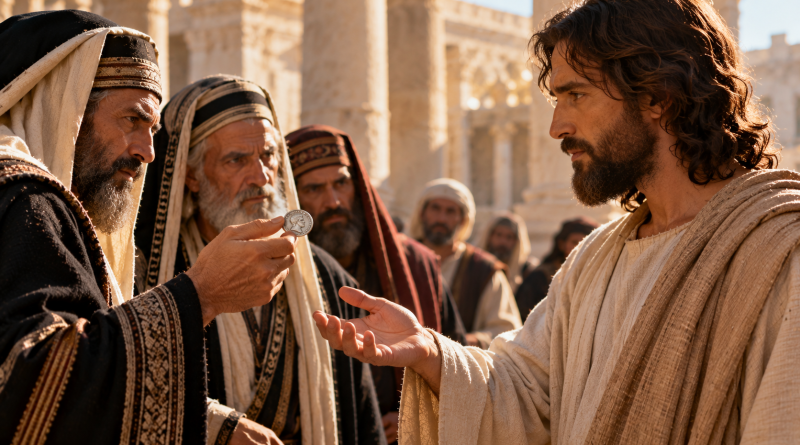
Jesus had no money with Him. So He asked them to show Him a coin. They handed Him a silver denarius. The coin bore Caesar’s image and an inscription declaring him to be the son of a god. The Jews did not use such money except when they had to pay taxes, which is why Jesus asked them to show Him the coin used for the tax. For everyday transactions, ordinary copper coins were used, bearing neither Caesar’s image nor that inscription, out of consideration for Jewish sensitivities. For the Jews, Caesar’s image and the claim that he was the son of a god constituted idolatry. Yet these men who had come to test Jesus carried such money with them, even in the Temple courtyard, making their hypocrisy all the greater. They had already, in a certain sense, aligned themselves with the authorities. And since the Herodians are mentioned here, they had probably also secured positions for themselves within the structures of government.
If they already carried the tax money, they were evidently prepared to fulfil their obligations to Caesar. So Jesus answered them, “Render to Caesar what is Caesar’s.” Since they possessed what belonged to Caesar, they should give it to him.
Yet the Pharisees were concerned only with Jesus’ attitude towards Caesar. Even among the rabbis of Jesus’ time, the obligation to pay taxes was not in question. They believed that taxes should be paid and that people should submit to the authorities, provided they were not required to reject the Torah or deny God.
Jesus was more concerned with their relationship with God. Whether we like it or not, we must pay taxes. This was true for Jesus’ contemporaries, and it remains true for us today. Besides taxes, they also had other payments to make. So do we. If we fail to meet our obligations, we will face legal consequences. Therefore, each of us makes an effort to fulfil our obligations to the state and to pay our household bills and other expenses on time.
But what about our relationship with God? Render to Caesar what is Caesar’s, but also to God what is God’s. The words “to God what is God’s” have sometimes been understood as cancelling out the preceding command. Even today, some people believe they have obligations only to God, and none to society or the state. But Jesus is clear. These obligations do not contradict one another—unless, of course, we are required to act against the Word of God. We must fulfil our obligations to the state, whether we like it or not. But do we give God what belongs to Him?
Do we give God our time? The time we have is God’s gift to us. Sometimes we find it difficult to make time for church, prayer, reading God’s Word, or doing good works. Our usual excuse is that we have no time. Time belongs to God. Let us give it to Him.
Do we give God our lives, our plans, our wills, and our whole being? Only when we are willing to offer ourselves to God as a living sacrifice can we expect blessings and a purposeful life—a life with meaning and direction. God does not wish to take anything away from us, but to give to us. To receive what He desires to give, we must first surrender ourselves completely to Him, placing ourselves in His hands so that He may shape us according to His will.
Do we give God our material resources? Many people are sensitive about this question. The Church is accused of being greedy and asking for money. Yet everything we have comes from God. Some people find it difficult to give a few dozen euros a year to the Church, while spending several hundred euros each month on cigarettes, alcohol, mobile phones, and similar things. Everything we have comes to us from God, from His fatherly hand. Are we willing to give Him what belongs to Him? At least ten per cent of our income? Someone will say, “But that no longer applies today. That is a Pharisaic rule.” Even if that were true—and it is not—it would mean that we should give still more. Jesus calls us to a righteousness that exceeds that of the scribes and Pharisees (Matthew 5:20).
The tithe belongs to God. Whenever we keep it for ourselves instead of giving it to God’s work, we withhold from God what is His; indeed, we rob Him (Malachi 3:8). Those who give to God’s work will certainly not be left without His provision. Of course, God does not need our resources if we give them reluctantly, thinking that we are doing something merely because we must, out of obligation. God loves “a cheerful giver” (2 Corinthians 9:7).
When we give God what belongs to Him, we will have everything we need. “Seek first the kingdom of God and His righteousness, and all these things will be added to you” (Matthew 6:33). A saying attributed to St Augustine puts it this way: “When God is in the first place, everything else is in its right place.”
Author: Bishop Jasmin Milić


Discover more from Horizonti vjere
Subscribe to get the latest posts sent to your email.
