
Green Light for Abortion, Administrative Silence for Persecuted Christians
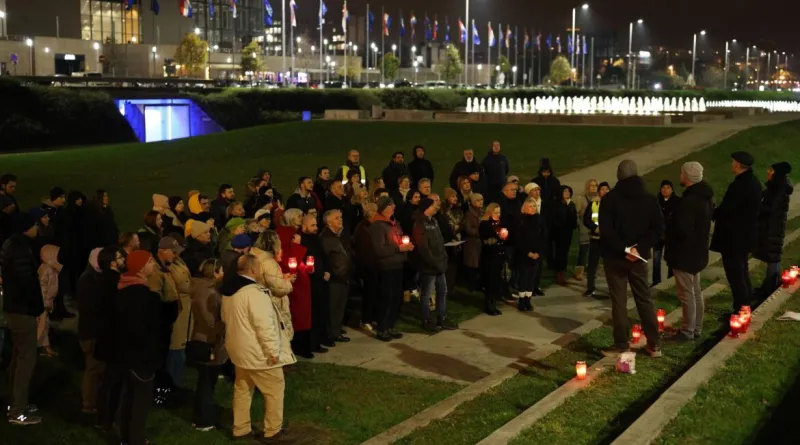
While the City of Zagreb allowed its fountains to be illuminated green to mark International Safe Abortion Day, a request by the Croatian Protestant Conference to illuminate the same fountains red in solidarity with persecuted Christians went unanswered in writing for months. The competent Ministry ruled that the appeal against administrative silence was justified and ordered the City to issue a decision within 15 days. However, it was not until October 2026 that the City discontinued the proceedings, explaining that the date of the planned commemoration had already passed. The case raises serious questions about the accountability of the city administration, equal treatment, and respect for freedom of religion.
The Fountains Shine for Some, While Others Receive No Timely Response
On 28 September 2026, Zagreb’s fountains were illuminated green to mark International Safe Abortion Day. As reported by the H-Alter news portal, Zagreb joined other European cities in symbolically illuminating public spaces to express support for the right to safe and accessible abortion.
The initiative was presented by the organisation CESI, and the illumination was intended to convey a message of support for women’s reproductive rights.
However, this event raises questions about the City of Zagreb’s attitude towards other initiatives that likewise appeal to fundamental human rights.
As early as the summer of 2025, the Croatian Protestant Conference requested that Zagreb’s fountains be illuminated red on 19 November of that year to mark Red Wednesday, an international initiative expressing solidarity with persecuted Christians.
The initiative draws attention to the millions of people who suffer violence, discrimination, imprisonment, expulsion, and even death because of their Christian faith.
The Croatian Protestant Conference’s request was not dealt with in a timely manner.
Instead of a decision before the planned commemoration, there followed months of administrative silence, an appeal before the competent Ministry, and ultimately a decision by the City of Zagreb discontinuing the proceedings because the date for which the illumination had been requested had already passed.
Such an outcome is difficult to interpret as anything other than a serious failure on the part of the city administration.
Particularly concerning is the fact that these are not merely allegations made by the applicant. The City of Zagreb’s unjustified failure to act was expressly established in an official decision issued by the Ministry of Physical Planning, Construction and State Assets.
Ministry Finds the Croatian Protestant Conference’s Appeal Justified
On 30 January 2026, the Ministry of Physical Planning, Construction and State Assets issued a decision, reference number UP/II-363-03/25-06/167, concerning the Croatian Protestant Conference’s appeal against the City of Zagreb’s failure to issue a decision.
The Ministry’s reasoning states that, on 11 August 2025, the Croatian Protestant Conference submitted a request to the City of Zagreb seeking permission for a red projection featuring a cross on Zagreb’s fountains to mark Red Wednesday on 19 November 2025.
It should be noted that the City of Zagreb’s subsequent decision gives 28 July 2025 as the date on which the request was submitted. This discrepancy between the two official documents requires clarification, but it does not change the fact that the request was submitted months before the planned event.
The Ministry established that the City of Zagreb had failed to decide on the request within the statutory period of 60 days prescribed by Article 101(2) of the General Administrative Procedure Act.
Significantly, while considering the appeal, the Ministry requested information from the City of Zagreb concerning the reasons for its failure to issue a decision and whether a decision had meanwhile been adopted.
The response, or rather the status of the case, did not justify the absence of a decision.
The Ministry expressly stated in its reasoning:
“Since the first-instance authority has not issued a decision on the appellant’s request even as of the date of drafting this decision, it must be concluded that the reasons for failing to issue a decision are unjustified.”
The Ministry then concluded:
“The appeal is well-founded.”
Consequently, the Ministry ordered the City of Zagreb to issue a decision on the Croatian Protestant Conference’s request within 15 days of receiving the Ministry’s decision.
This document is particularly important because it demonstrates that the problem was not simply the applicant’s dissatisfaction. The competent state authority officially established that the city administration had unjustifiably failed to act.
The Ministry did not order the City to approve the illumination of the fountains, but rather to issue a decision on the submitted request. Yet this is precisely what is expected of public authorities: that they decide on applications promptly, lawfully, and with proper reasoning.
The City Failed to Comply with the Ministry’s Deadline
The Ministry’s decision was issued on 30 January 2026.
It gave the City of Zagreb 15 days from receipt of the decision to reach a determination.
However, the City of Zagreb did not issue its decision until 14 October 2026, more than eight months after the Ministry’s ruling.
Although the available documents do not establish the exact date on which the City received the Ministry’s decision, the interval between the two decisions clearly demonstrates how prolonged the proceedings became.
What is particularly absurd is the content of the City of Zagreb’s final decision.
Instead of making a substantive determination on the request, the city administration concluded that the proceedings should be discontinued because the date of the planned commemoration had already passed.
The result is something that should cause serious concern in a state governed by the rule of law: a public authority failed to decide on a request in a timely manner; the competent Ministry established that this failure was unjustified; and the city administration subsequently cited the passage of time as the reason for discontinuing the proceedings.
In other words, the applicant did not receive a timely decision, and when a decision was finally issued, the applicant was informed that there was no longer any point in considering the request.
Administrative Cynicism: You Waited Too Long, Now It Is Too Late
On 14 October 2026, the Mayor’s Office of the City of Zagreb, specifically its Sector for Urban Development and the Use of Public Spaces, issued decision UP/I-363-02/25-027/783, discontinuing the proceedings.
In its reasoning, the City invoked Article 46(5) of the General Administrative Procedure Act, which permits proceedings to be discontinued when the legal prerequisites for conducting them cease to exist.
The City stated:
“Given that the applicant’s request to hold a projection on the water wall of the fountains concerned 19 November 2025, and since that date has passed, it has been established that the legal prerequisites for continuing the proceedings no longer exist and that further action in the matter would serve no purpose.”
Such reasoning raises the question of whether this manner of proceeding may, in fact, have been deliberate.
The Croatian Protestant Conference did not submit its request after the planned event. It submitted it months beforehand.
The City of Zagreb failed to decide on the request in a timely manner.
The Ministry established that the reasons for failing to issue a decision were unjustified.
Then, after several additional months of waiting, the City concluded that the time had passed.
Was it not the city administration’s own conduct that contributed to the request losing its purpose?
Can a public authority, through its own inaction, place an applicant in a situation where fulfilling the request becomes impossible, and then use that very impossibility as grounds for discontinuing the proceedings?
It is difficult not to describe such conduct as administrative cynicism.
The issue here is not necessarily limited to the formal application of Article 46 of the General Administrative Procedure Act. It also concerns how a situation arose in which that provision was applied only after the public authority had failed to make a timely decision.
The final decision provides no answer as to why the request was not resolved before 19 November 2025.
Nor does it explain why so much time elapsed after the Ministry determined that the appeal was justified.
These are questions that the City of Zagreb should answer publicly.
Why Should Solidarity with Persecuted Christians Be a Problem?
Red Wednesday is an international initiative that draws attention to the persecution of Christians throughout the world.
With the significant involvement of the international Catholic charity Aid to the Church in Need, the initiative brings together Christians from different traditions, as well as all those who care about freedom of conscience and religion.
In numerous European cities, churches, public buildings, and landmarks are illuminated red.
The colour red symbolises the blood of martyrs and the suffering of those persecuted because of their faith.
According to reports by the international organisation Open Doors, hundreds of millions of Christians live in countries where they face high levels of persecution and discrimination.
In some countries, Christians are victims of attacks by extremist groups, abductions, imprisonment, forced displacement, the destruction of churches, and murder.
Such suffering is not merely an internal concern of Christian communities. It constitutes a serious violation of fundamental human rights.
Freedom of religion does not belong exclusively to Christians. It belongs to every human being, regardless of religion or belief.
For precisely this reason, solidarity with persecuted Christians should not be a matter of ideological controversy.
The City of Zagreb does not have to embrace Christian theology in order to express solidarity with people who suffer because of their faith.
Likewise, one does not need to be a Christian to condemn violence against Christians.
Why, then, could the Croatian Protestant Conference’s initiative not receive a timely decision?
And why was it necessary to wait so long, only for the proceedings ultimately to be discontinued?
Human Rights Must Not Depend on Ideological Acceptability
The City of Zagreb frequently emphasises its commitment to tolerance, inclusion, equality, and human rights.
Such principles deserve support.
However, their credibility is not measured solely by the treatment of initiatives that align with the worldview of the current city administration.
Genuine tolerance is demonstrated precisely in the treatment of those who think differently.
If the city authorities can permit the illumination of fountains to mark International Safe Abortion Day, it is legitimate to ask why they could not make a timely decision on a request to illuminate those same fountains in solidarity with persecuted Christians.
It is particularly concerning when such inaction affects an initiative originating from a religious community.
The Croatian Protestant Conference has previously raised concerns about possible religious discrimination in connection with this case.
The available documents do not, in themselves, prove that discrimination has been legally established, although such discrimination may be suspected. They do, however, unequivocally confirm that the City of Zagreb unjustifiably failed to decide on the request in a timely manner, as established by the competent Ministry.
That alone is a serious problem.
The Zagreb Fountains Case Has Also Been Documented Internationally
The City of Zagreb’s treatment of the Croatian Protestant Conference has not gone unnoticed internationally.
On 9 July 2026, the Vienna-based Observatory on Intolerance and Discrimination Against Christians in Europe (OIDAC Europe) included the case in its international database under the title “Zagreb Reported for Religious Discrimination After Blocking Red Wednesday Commemoration.”
The report states that the City of Zagreb failed to decide in a timely manner on the request to illuminate the fountains in solidarity with persecuted Christians, even after the competent Ministry ordered it to issue a decision.
The Observatory also highlights an additional problem involving a parking space in front of the entrance to the Croatian Protestant Conference’s premises, which are also used for worship services by the Evangelical Methodist Church. According to the report, this has made access more difficult for worshippers, particularly wheelchair users.
Although it has not been officially established that this constituted deliberate discrimination or retaliation, the fact that the case has been documented on an international platform monitoring violations of religious freedom in Europe further underlines its seriousness.
The question of Zagreb’s fountains is therefore no longer merely a local administrative dispute. It has also become a matter concerning the City of Zagreb’s reputation regarding respect for religious freedom and equal treatment of Christian communities.
The Problem Is Not the Green Light, but the Absence of Red
It must be stated clearly: the problem is not that Zagreb’s fountains were illuminated green to mark International Safe Abortion Day.
As Christians who uphold a conservative understanding of the sanctity of human life, we consider abortion morally unacceptable because we believe that human life is a gift from God deserving protection from the moment of conception.
Our conviction arises from the biblical understanding of human beings as created in the image of God and from our responsibility to protect life, especially the most vulnerable.
At the same time, however, we believe that God has given human beings freedom of choice, including the possibility of making decisions contrary to His will.
Freedom of conscience also entails the right of others not to share our religious and moral convictions.
Therefore, although we clearly oppose abortion and regard it as contrary to God’s will, we do not deny others the freedom to advocate different positions.
Our task is to bear witness to the truth in love, protect the dignity of every human being, and promote a culture of life, rather than impose faith through coercion.
It is precisely for this reason that we expect our convictions, and our right to express them publicly, to be respected equally alongside the convictions of those who think differently.
In a democratic society, different organisations have the right to advocate their beliefs publicly and promote initiatives they consider important.
The problem arises when the impression is created that certain initiatives receive institutional support while others encounter administrative silence and months of delay.
In one case, Zagreb’s fountains became a platform for a public message.
In the other, involving solidarity with persecuted Christians, the request remained unresolved until the event had passed.
And when the competent Ministry established that the appeal against administrative inaction was justified, the City did not promptly resolve the matter but discontinued the proceedings months later.
A comparison of these two initiatives alone cannot establish that deliberate discrimination occurred.
But it can, and must, raise questions about consistency.
If the City of Zagreb is prepared to use the public illumination of fountains to express support for various social initiatives, it must ensure that all applicants have equal access to the decision-making process.
That includes religious communities.
That includes Protestant churches.
That includes initiatives that may not align with the political and ideological positions of the city authorities.
Human rights are not the property of any one political group.
They must not be divided into acceptable and unacceptable colours.
The City of Zagreb Owes an Explanation
The Croatian Protestant Conference did not ask the City of Zagreb to embrace its religious convictions.
It did not seek a political declaration in favour of Protestantism.
It did not demand a privileged position for Christians in society.
It requested the opportunity to illuminate Zagreb’s fountains red as a sign of solidarity with people persecuted because of their Christian faith.
Such an initiative should be understandable to anyone who takes human rights seriously.
Instead of a timely response, prolonged administrative proceedings followed.
The Ministry determined that the appeal was justified.
The City ultimately concluded that it was too late to decide.
This raises questions that extend far beyond this individual case.
Why did the City of Zagreb fail to decide on the request before the planned Red Wednesday commemoration?
Why was it necessary for the Ministry to intervene and establish that the City’s failure to act was unjustified?
Why was the final decision not issued promptly after the Ministry’s order?
And, most importantly, would every other organisation requesting the use of Zagreb’s fountains to mark a socially significant cause have been treated in the same way?
The city administration should provide clear answers to these questions.
For Zagreb, as the capital of the Republic of Croatia, must be a city for all its citizens.
A city for believers and non-believers.
A city for people of different political and ideological convictions.
A city where human rights are promoted consistently rather than selectively.
Zagreb’s fountains may shine green, red, or any other colour. But human rights must not be restricted to those colours acceptable to the current city administration.
If the City of Zagreb can permit the symbolic illumination of its fountains in support of abortion rights, then it must, at the very least, make a timely and reasoned decision on a request to express solidarity with persecuted Christians.
And when a public authority fails to issue a decision on time, when the competent Ministry establishes that such inaction was unjustified, and when the proceedings are ultimately discontinued because the date of the event has passed, the problem is no longer simply the colour of the fountains.
The problem is the accountability of public authorities.
Solidarity that depends on the ideological acceptability of those to whom it is extended ceases to be universal solidarity.
The question therefore remains, and the City of Zagreb should answer it:
Why could Zagreb’s fountains shine green in support of abortion rights, but not red in solidarity with persecuted Christians?
Sources and Documentation
1. H-Alter, “Zagreb Joins 11 European Cities in Marking International Safe Abortion Day,” 2026.
https://h-alter.org/vijesti/zagreb-se-pridruzuje-11-europskih-gradova-u-obiljezavanju-medunarodnog-dana-sigurnog-pobacaja/
2. Ministry of Physical Planning, Construction and State Assets, Decision of 30 January 2026, Reference: UP/II-363-03/25-06/167, URBROJ: 531-03-4-26-3.
3. City of Zagreb, Mayor’s Office, Decision of 14 October 2026, Reference: UP/I-363-02/25-027/783, URBROJ: 251-02-52-1/001-26-5.
4. Croatian Protestant Conference, public statements concerning the Red Wednesday initiative and the conduct of the City of Zagreb.
5. Open Doors, World Watch List, international reports on the persecution of Christians.
6. OIDAC Europe, report concerning the Zagreb Red Wednesday case, 9 July 2026:
https://www.intoleranceagainstchristians.eu/index.php?id=12&case=12000


Discover more from Horizonti vjere
Subscribe to get the latest posts sent to your email.
