
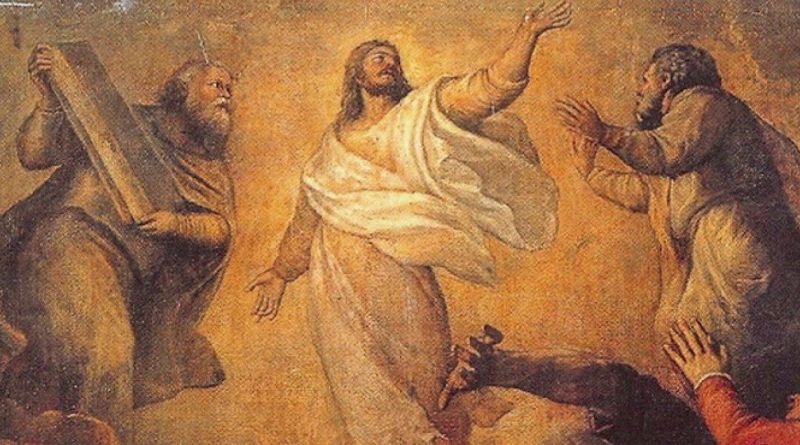
Sermon for the Feast of the Transfiguration of the Lord
”After six days Jesus taketh Peter, James, and John his brother, and bringeth them up into an high mountain apart, and was transfigured before them: and his face did shine as the sun, and his raiment was white as the light.” Mt 17:1-2
The Transfiguration of the Lord
Six days before the Transfiguration, Christ revealed to His disciples what would happen to Him in Jerusalem: that He would suffer greatly at the hands of the elders and chief priests, that He would be killed, and that on the third day He would rise again (Matt. 16:21). He also told them that He would come again in His glory “with His angels, and then He shall reward every man according to his works” (Matt. 16:27).
So, six days after that discourse, Christ takes Peter, James, and John with Him and goes with them to a “high mountain.” Although the Gospel does not specify which mountain, Christian tradition from the earliest times holds that it was Mount Tabor. That mountain, or rather hill, is located in Lower Galilee, 18 km west of the Sea of Galilee. Tabor is 588 meters high. Its name means “dome,” which reflects its shape.

Before the Israelites, the Canaanites had their sanctuary on Tabor. Today, at its summit stands a Roman Catholic Franciscan basilica, whose crypt contains visible remains of that ancient Canaanite sanctuary. There is also an Orthodox church at the summit. Since the 4th century, Tabor has become a place of Christian pilgrimage.
The Evangelist Luke gives us the reason why Christ went up the mountain with His disciples: “…Jesus took with Him Peter, John, and James and went up onto the mountain to pray” (Luke 9:28). Christ often prayed, and thus, though truly God, yet also truly man, gave us an example of a life of prayer. If He needed prayer, how much more do we!
During prayer, the Transfiguration takes place, in which Christ is revealed as true God and true man. It is, in fact, an epiphany, a manifestation of God. The two natures of Christ—human and divine—are revealed, united in one person. Just as at Christ’s baptism, a voice is heard from heaven: “This is my beloved Son, in whom I am well pleased; hear ye Him.” The voice comes from a cloud. When the people of God journeyed through the wilderness toward the Promised Land, the cloud represented God’s presence and His guidance. Here, too, the cloud represents the presence of God, the glory of God, of which Christ had spoken to His disciples (Matt. 16:27), and also the third Person of the Holy Trinity—the Holy Spirit. Thus, the Transfiguration is indeed a theophany, a revelation of the Holy Trinity.
During the Transfiguration of Christ, Moses and Elijah appear as representatives of the Law and the Prophets, the customary name for the Scriptures of the Old Testament in Christ’s time. They appear as witnesses that Christ is the One of whom “the Law and the Prophets” spoke (Luke 24:27). Moreover, Moses is an image of Christ’s human nature, for it is said that he died, but his grave is unknown, while Elijah represents His immortal, divine nature, for it is said that Elijah did not die but was taken up into heaven. Moses also spoke prophetically of the coming Messiah (John 1:45; Luke 24:27), and Elijah was foretold as the one who would appear before the coming of the Messiah (Mal. 4:5). Moses had longed to see God’s glory, but the Lord told him that no one could see Him and live (Ex. 33:20). Now, on Mount Tabor, Moses beholds the glory of the Lord’s face, revealed in the person of the Lord Jesus Christ.
While Christ was being transfigured, the Evangelist Luke tells us that Peter, John, and James had fallen asleep. Christ surely had a reason why He took those three with Him up the mountain. He trusted them and considered them spiritually mature enough to endure His divine transfiguration. As the hymn (troparion) of the Christian East for the Transfiguration says, the Lord showed them His glory “as much as they could bear.”
Yet even the best among the best grew weary and fell asleep. In the end, Christ remained alone in prayer. In a certain way, here is revealed what will happen in His final days on earth: the disciples will be afraid and scatter. Even Peter will deny Him three times. Christ will be left alone. In the moment of mortal agony, He will feel forsaken even by the heavenly Father (Mark 15:34). Through all that spiritual anguish, Christ endures out of love for mankind.
When they awoke and saw Christ speaking with Moses and Elijah, they desired to remain on Tabor. The Apostle Peter said to the Lord, “Lord, it is good for us to be here; if You will, let us make here three tabernacles: one for You, one for Moses, and one for Elijah.” The Apostle Peter wished to build three tabernacles. Tabernacles were built for the Feast of Tabernacles, which was one of the three pilgrimage feasts. The Jewish Feast of Tabernacles celebrated God’s dwelling among His people, and Christ’s Transfiguration reveals how that dwelling is fulfilled through Christ, the Messiah and God-man. There is no doubt that Christ’s Transfiguration occurred during the Feast of Tabernacles, and that the celebration of this event in the Christian Church became the New Testament fulfillment of that Old Testament feast, just as Passover and Pentecost were fulfilled.
The Apostle Peter believed that the moment had come for the final revelation of the Messiah and that the time had come for the establishment of Christ’s earthly kingdom. But the hour of Christ’s final glorification had not yet come, so He tells them at the end: “Tell the vision to no man, until the Son of man be risen again from the dead.” Not even Christ’s disciples would understand the true nature of His messiahship until His Resurrection, and fully only when the Holy Spirit descended upon them on the day of Pentecost.
The Transfiguration is the goal to which every Christian must strive. For only the transfigured can enter the Kingdom of God. Our transfiguration is a journey up the “high mountain.” On that journey, by overcoming obstacles and acquiring necessary virtues, we grow “unto the measure of the stature of the fulness of Christ” (Eph. 4:13), becoming increasingly Christ-like. That is transfiguration—a change that must be visible in our spiritual life and which cannot happen without communion with God.
Christ’s Transfiguration occurred during prayer. Christ took the disciples with Him up the mountain to show the importance of communal prayer—liturgical fellowship. It is there that Christ’s light shines upon us and transforms us. In the end, when the Lord comes, He will, as the holy Apostle Paul tells us in Philippians 3:21, “transform our lowly body to be like unto His glorious body.” May the Transfiguration be our reality both in this age and in the age to come. Amen.

Discover more from Horizonti vjere
Subscribe to get the latest posts sent to your email.
